Outdoor Play

6 Best Yo-Yos 2026: Tested Picks for Kids and Beginners

Our tested yo-yo picks cover first throws, auto-return, string tricks, and advanced binds, with clear advice on weight, response, and durability.

A yo-yo is a weighted wheel on a string, and that's about where the simplicity ends. The detail that decides whether a beginner sticks with it is the response system: a responsive yo-yo grabs the string and climbs back to your hand, while an unresponsive one free-spins on a bearing and waits for you to learn to bind it. Hand a first-timer the second kind and the fun dies somewhere around the tenth unspooled tangle. The right yo-yo, at any skill level, is simply the one that matches the hands holding it.

I've been throwing since a fifth-grade playground phase and still keep one in my desk drawer. Over the past three months my team and I worked through 16 yo-yos — plastic and metal, beginner-friendly and competition-leaning — and the pattern held: the good ones feel settled in the hand, respond predictably, and survive the driveway. Price told us almost nothing about quality; more than one cheap model out-threw a fancier one. The picks below are the ones we kept reaching for after the testing was technically over.

#1

MAGICYOYO V3

MAGICYOYO V3

All-round skill progression

Doodle Score 9.2/10
Check Price

Worth Noting

  • Stock strings wear quickly with heavy practice
Weight
2.29 oz
Included
12 strings, case, bearing tool
Body Material
Aluminum alloy
Response Modes
Responsive and unresponsive
Read the full review

The V3 is the one we recommend to most families because it changes with the player: it arrives set up responsive, with a bearing that returns with a tug, and the box also includes a wider unresponsive bearing for later. That two-stage setup is the difference between a yo-yo that gets put down after a week and one that can follow a kid into real string tricks. The aluminum body gives it a planted, stable feel that the plastic models here cannot match, and at 64.9 g it still feels compact in a child's hand.

The extras matter more than they look. Twelve strings, a bearing tool, and a case mean you can deal with the first frayed string without ordering anything, and the tool makes the bearing swap less intimidating. We like that the V3 starts out easy but leaves room to learn a bind; the same yo-yo can serve a beginner and a kid who is ready for unresponsive play.

A metal body is not the gentlest choice for a very young child, and the V3 is at its best with a player who is at least around eight and can handle a missed catch. For that kid, the solid feel is the point. It is a first serious yo-yo, not a toddler toy, and the difference shows in how calmly it spins.

Bottom line: For most kids and beginners, we recommend the MAGICYOYO V3 because its dual response setup can take a player from first throws to unresponsive tricks without another purchase.

#2

Yomega Brain

Yomega Brain

Auto-return first throws

Doodle Score 9.0/10
Check Price

Worth Noting

  • Plastic build and string wear first
Weight
2.08 oz
Skill Level
Beginner
Body Material
Plastic
Return System
Centrifugal clutch auto-return
Read the full review

For a child who has never made a yo-yo come back, the Yomega Brain is the one we reach for. Its centrifugal clutch lets the yo-yo sleep on the down swing and then engages as the spin slows, so the return happens without a tug. That takes the most frustrating part of learning out of the first session. The plastic body is light, the shape is familiar, and the whole thing feels like a toy a kid can carry in a pocket.

The Brain is happiest with the classics: Walk the Dog and Around the World are exactly its speed. The included instructions cover the basics, and the simple clutch means a child can build rhythm before worrying about technique. It is not the model we choose for long sleeper combos or a modern bind, but that is a different stage of the hobby.

Where it fits best is a first yo-yo for a young beginner who needs to feel success quickly. The 59 g body is easy to carry to a park or a grandparent's house, and the automatic return keeps the toy from ending up under the sofa every few throws. It is the yo-yo we leave in a bag for spontaneous practice.

Bottom line: We hand the Brain to the youngest beginner because the clutch returns the yo-yo without a tug, while older kids will want more trick range.

#3

Duncan Butterfly XT

Duncan Butterfly XT

Budget string tricks

Doodle Score 9.0/10
Check Price

Worth Noting

  • Stock string frays sooner than the body
Axle
Ball bearing
Weight
2.08 oz
Body Shape
Wide butterfly
Skill Level
Intermediate
Read the full review

The Butterfly XT is the cheapest way into a wide-body string-trick yo-yo, and it makes that budget feel less like a compromise than it should. The flared butterfly shape opens up the string gap, so landing the yo-yo back on the string is easier than with a narrow beginner body. The ball-bearing axle gives it a longer sleep than a fixed-axle toy, and the plastic takes knocks without much drama.

We reach for this one when a kid has learned the basic return and wants to start landing tricks. It is responsive, not auto-return, so the player still has to learn the tug, and the wide body makes the string easier to catch. The take-apart design is a practical touch: a knot in the string is less of a crisis when the halves come apart.

What holds it back is consistency. A good throw can feel smoother and longer than the next. For learning string tricks that is acceptable, because the wide gap and low cost buy room to practice. We do not treat it as the no-fuss first yo-yo for a five-year-old, but it is a fine step up for a kid who already knows how to make a yo-yo return.

Bottom line: We recommend the Butterfly XT for a beginner ready to learn string tricks on a budget; its wide body and ball bearing make practice forgiving.

#4

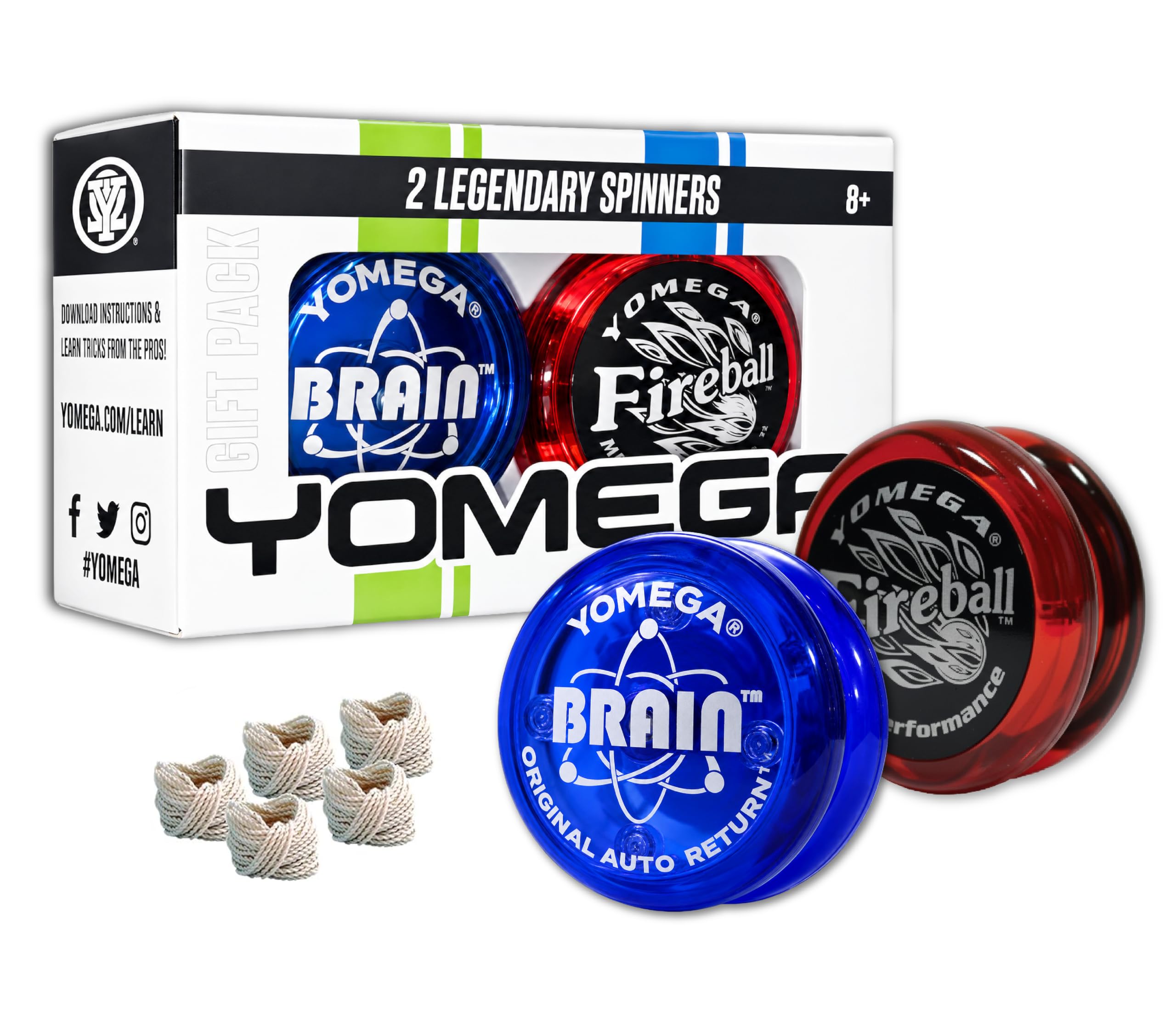
Yomega Legendary Spinners Set

Yomega Legendary Spinners Set

Two-stage gifting

Doodle Score 9.0/10
Check Price

Worth Noting

  • Fireball's balance is less dependable
Skill Level
Beginner to intermediate
Extra Strings
5
Return Systems
Auto-return and transaxle
Included Yo-Yos
Brain and Fireball
Read the full review

The Yomega Legendary Spinners set puts two different yo-yos in one box: the Brain with its auto-return clutch and the Fireball with a transaxle for longer, responsive play. That split is the appeal. One can go to a younger beginner who needs the yo-yo to come back on its own, while the other suits a kid who has learned the basics and wants to work on string tricks.

As a gift, it solves the usual guess. The Brain is the easier of the two and the one we hand over first; the Fireball asks for a tug and rewards a player who is ready to practice. Five extra strings are included, and the pair covers more ground than a single beginner model without asking the buyer to choose a skill level in advance.

The catch is that a set asks for two players or two stages. The Brain is the safer first claim; the Fireball is the one an older kid will want to claim. For siblings or a birthday present, that is an easy trade to accept, and the pair covers more ground than a single beginner model without forcing a choice between them.

Bottom line: For a gift that covers two stages, we like the Legendary Spinners set: the Brain handles first throws while the Fireball gives an older kid more to grow into.

#5

Duncan First Yo!

Duncan First Yo!

Toddler first throws

Doodle Score 9.0/10
Check Price

Worth Noting

  • Stock string wears with use
Weight
2.12 oz
Skill Level
Beginner, ages 5 and up
Body Material
Soft silicone
String Length
Shorter than standard
Read the full review

The First Yo is built for the child who is not ready for a real sleeper yet. The body is soft silicone, the string is shorter than standard, and the response is immediate, so the yo-yo comes back with almost no effort. That combination is why we keep it in the toddler-and-preschool conversation: a missed catch is less painful, and a short string gives small hands a manageable loop.

We recommend it as a first taste of yo-yoing, not as the only yo-yo a family buys. It does not sleep, which means Walk the Dog, Around the World, and proper string tricks are off the table; it is an up-and-down toy with a soft landing. For a four- or five-year-old who wants to do what an older sibling is doing, that is enough.

The softness has a second benefit: it makes the yo-yo less intimidating when a child is learning the motion. An adult still needs to be nearby, because a yo-yo string is not a necklace, but this is one of the few picks we can picture a preschooler using without a parent wincing at every miss.

Bottom line: For a toddler's first throws, we like the First Yo: the soft body, short string, and instant return make the toy manageable before real tricks matter.

#6

MAGICYOYO N11

MAGICYOYO N11

Advanced bind play

Doodle Score 8.8/10
Check Price

Worth Noting

  • 120 g body tires smaller hands
Weight
4.23 oz
Included
12 strings, glove, sack, bearing tool
Body Material
Aluminum alloy
Response Mode
Unresponsive with bind; responsive kit included
Read the full review

At 120 g, the N11 is the heavyweight of this group, and that is the first thing you notice when you pick it up. The extra mass makes the yo-yo feel planted at the end of a hard throw, and the aluminum body keeps a steady spin through longer combinations. This is a tool for a player who already understands a bind; the concave bearing is set up unresponsive, so it will not come back just because the spin slows.

We recommend it for the player who has outgrown a tug-return yo-yo and wants to practice real string tricks. The included responsive bearing makes it easier to hand to a beginner, but the N11's personality is unresponsive metal. The glove and sack are useful extras, and the bearing tool makes the swap manageable. It is the pick we reach for when a player asks for more spin.

The weight is the point rather than a side effect: it carries momentum through a long spin and makes the yo-yo feel steady at the end of the string. A missed catch still has consequences, because this is metal, not the soft silicone of the First Yo. We see the N11 as a piece of equipment to grow into, not a toy to hand to a five-year-old.

Bottom line: We reserve the N11 for players who can already bind: its heavy aluminum body gives advanced tricks a stable platform, and its responsive kit is there for practice.

How We Tested the Yo-Yos

We started by gathering every yo-yo selling in real numbers with reviews specific enough to be useful, then filtered for a spread of response systems, materials, shapes, and prices rather than a single bracket. That left 16 models, from basic plastics aimed at kids to metal throws built for string tricks. Each one got a fresh string, its own notebook page, and twelve weeks of use.

Testing happened where yo-yos actually get thrown: living room carpet first, since that's where most people learn and where a bad throw hits the floor, then sidewalks, a driveway, a park, and one long stretch of office hallway. I threw alongside a nine-year-old complete beginner, two adults who had never landed a trick, and a couple of us who could already do a trapeze, and we put every model in all of their hands. We counted how many tries it took a first-timer to get five clean returns in a row, and noted whether the yo-yo snapped back hot enough to sting a palm or limped up so weakly it never cleared the string.

For trick ability we timed sleepers with a stopwatch, watched whether each model stayed on plane through a throw, and worked through the same short list of mounts and string tricks on all 16. Durability got less gentle treatment: deliberate drops on concrete, kids banging them together, and a check after every session for wobble, cracked shells, stripped axles, worn response pads, and fraying string. Throughout, we tracked whether a yo-yo still answered the string at week ten the way it did on day one — that kind of retention matters far more here than any spec sheet — and whether the build ever justified what it cost.

How to Choose

Choose the Return Before the Tricks

The first decision is whether the yo-yo returns with a tug, on its own, or only after a bind. A responsive yo-yo is the right starting point for most kids: it comes back with a small tug, so they learn the throw and catch while keeping the toy under control. An auto-return clutch, like the Yomega Brain's, removes even that tug and suits a very young beginner. An unresponsive metal yo-yo such as the MAGICYOYO N11 needs a bind, and it will feel broken to anyone who has not learned one.

The common mistake is buying the most advanced model for a child who has never thrown. A bind is a separate skill, not a feature that appears with a higher price or a metal body.

Match Body Shape and Weight to the Player

Wide butterfly bodies, such as the Duncan Butterfly XT's, open the string gap and make landing tricks easier; slimmer shapes are more about control and looping. Weight is the other half. A light plastic body is easy to carry and forgiving of a clumsy throw, while the 120 g MAGICYOYO N11 feels planted in a long spin but tires smaller hands.

We start beginners on the lighter side and move up only when they ask for more spin. If the player is still learning to catch, lighter and softer wins; if they are chasing spin time, extra mass can help.

Budget for Strings and Bearings, Not Just the Yo-Yo

Strings are consumables. They fray, get dirty, and snap, especially while a beginner is learning to bind or catch. A yo-yo that includes a dozen strings and a bearing tool, like our top pick, saves a return trip and keeps practice going. Bearings also change personality: a narrow responsive bearing returns with a tug, while a wider unresponsive bearing demands a bind. If you plan to switch, keep the two bearings labeled and use the tool rather than forcing the halves.

Buy for Age and Impact, Not Just Skill

A soft silicone body and a short string, as on the Duncan First Yo!, make a yo-yo manageable for a preschooler and less painful on a missed catch. Most metal models here are recommended for ages eight and up, and we treat that as a real boundary rather than a suggestion: a metal rim hitting a younger child hurts more and dents more easily.

A wide plastic body is the sensible middle ground for a six- or seven-year-old who is ready for real tricks but still drops the yo-yo constantly.

Frequently Asked Questions

Final Verdict

For most families, the MAGICYOYO V3 is the yo-yo we recommend: it starts responsive, includes the parts for unresponsive play, and gives a kid room to grow without buying twice. If the player is very young, the Yomega Brain's auto-return removes the hardest part of the first lesson. If they already bind and want a heavier metal platform, the N11 is the step up.