Pretend Play

8 Best Play Kitchens of 2026: Tested and Ranked

We tested play kitchens with toddlers and preschoolers. Here's which ones fit small rooms, survive siblings, and still look good in the living room.

Every play kitchen looks adorable on the product page. Then the box arrives a bag of screws short, the instructions are 30 steps of wordless diagrams, and you're on the living room floor at 11 p.m. questioning the whole idea. Stay with it. A good one turns a corner of the house into a place where a four-year-old cooks dinner for an imaginary crowd and stays there — absorbed, independent, and quieter than you'd expect — for a genuinely surprising stretch of time.

What separates a keeper from a wobbly disappointment is rarely the paint job. It's whether the doors still close after a year of being slammed, whether the knobs actually turn, whether the counter is wide enough for two kids, and whether the thing fits where you want it. We've spent the past six months building, wiping down, and living with 12 play kitchens alongside kids aged 2 to 6. One note before you fall for a farmhouse sink: the footprint is almost always bigger in person than in the photo, so measure first.

#1

Step2 Fun with Friends

Step2 Fun with Friends

Small rooms

Doodle Score 9.4/10
Check Price

Worth Noting

  • Screws go into undrilled plastic
  • Decals take patience to line up
Material
Plastic
Assembled Size
40.88" H x 35.75" W x 12.5" D
Lights And Sounds
Burner light and sizzle
Included Accessories
25 pieces
Read the full review

Twelve and a half inches of depth is the number that won us over. Set against a wall, this kitchen takes less floor than a bookshelf, and at 35.75 inches wide it slid into the gap between a doorway and a sofa that none of the wooden kitchens here could use. If your play space is really a corridor, start reading here.

The tidiness is the part we kept coming back to. Every one of the 25 accessories has a molded spot, so a two-year-old can put the pans away without being told where they go, and the pod coffee maker, sink, faucet and opening fridge and oven doors hand a small child a lot of small jobs. The burner lights and sizzles when a pan goes on it, which takes two AA batteries that aren't in the box, and that one piece of feedback made the biggest difference to how long a child stayed at it.

Two things to know before you order. The screws drive straight into the plastic with no pre-drilled holes, which is normal for Step2 and the reason assembly divides opinion; a screwdriver and a spare hour covers it. The decals also want a steady hand and a straight eye. The 2-to-10 age claim is generous in practice, since this is a toddler-to-preschool kitchen and by six most children have moved on.

What you don't get is wood, or a statement piece. Against the KidKraft Vintage it gives up the furniture look; against the Heart of the Home it gives up the wide counter and the bigger accessory set. What it keeps is the easiest kitchen in this group to fit, clean, and put away properly at the end of the day.

Bottom line: We send most families here: it fits a narrow wall, keeps all 25 accessories tidy, and gives a toddler a working sink, oven and sizzling burner.

#2

Step2 Heart of the Home

Step2 Heart of the Home

Sibling play

Doodle Score 9.4/10
Check Price

Worth Noting

  • 48 inches tall, a stretch for toddlers
  • The most expensive kitchen here
Setting
Indoor or outdoor
Material
Plastic
Assembled Size
48" H x 45.13" W x 12" D
Included Accessories
40 pieces
Read the full review

Two children can stand at this counter at the same time, and that single fact is why it earns a place. At 45.13 inches wide and 48 inches tall, with 12 inches of depth, it's the widest kitchen in this guide, broad enough for a four-year-old at the oven and a two-year-old at the sink without either of them giving ground.

The 40-piece accessory set is the largest here, and the interactive side is genuinely good: the burner crackles or bubbles depending on which pan you set down, there are storage bins for the pieces, and the whole thing wipes down for patio use. The pet dishes molded into the base are the detail that charmed us. Feeding an imaginary dog while the dinner cooks is exactly the kind of side errand that keeps pretend play running.

It's also the tallest kitchen here, and that cuts both ways. A three-year-old works comfortably at the counter, but the top shelf is a stretch for a two-year-old, who will get more out of it next year. It's the priciest set in this group, though at 25 pounds it's still light enough to shift alone when the playroom needs to be a guest room again.

Bottom line: For two children cooking at once, this is the kitchen to buy: wide, sturdy, generously stocked, and the only one here that can move to the patio.

#3

KidKraft Ultimate Corner

KidKraft Ultimate Corner

Corner spaces

Doodle Score 9.4/10
Check Price

Worth Noting

  • Multi-hour build with picture-only instructions
Material
Engineered wood
Age Range
3 to 10 years
Assembled Size
42.5" D x 32.5" W x 36.75" H
Lights And Sounds
Burners and water dispenser
Read the full review

Corners are where playrooms hide their dead space, and this is the kitchen built to claim one. It runs along two walls rather than one, so the awkward junction of a room becomes the busiest spot in it and the middle of the floor stays clear.

The details are what lift it above the plastic sets: engineered wood instead of molded shell, fabric curtains at the window, a wall phone, and a washer with an inset round door that turns laundry into part of the game. The burners light and make cooking sounds, and the water dispenser lights up when pressed. It's rated three to ten years, optimistic at the top end and about right through the preschool years.

Assembly is the honest cost. This is a many-parts build with picture-only instructions, and a few hours is the realistic estimate rather than a few minutes. What you get for it is a unit that doesn't wobble once it's square, because the L shape braces itself, and doors that line up and keep lining up. We think it's worth the evening if you have the corner. If you don't, the Vintage gives you the same wood in 13 inches of depth.

Bottom line: Buy it if you have a corner going spare: solid wood, a washer, curtains and a phone, and the most furniture-like thing here once the long build is behind you.

#4

Minnie Mouse Brunch Cafe

Minnie Mouse Brunch Cafe

Minnie fans

Doodle Score 9.4/10
Check Price

Worth Noting

  • Light plastic for the money
  • Pieces have arrived missing or broken
Material
Plastic
Age Range
3 to 8 years
Batteries
3 AAA (not included)
Included Accessories
Waffle maker, food, dishes
Read the full review

If a three-year-old in your house can spot Minnie Mouse at forty paces, the search is basically over. This is a narrow brunch counter rather than a full kitchen: Minnie phrases, a burner that lights and sounds, a spinning waffle maker, a cereal dispenser and a coffee pot, all built around the character rather than bolted on afterwards.

The accessory list is the fun part — two waffles, a muffin tray with two muffins, a frying pan, a fried egg, a spatula, plates, cups and play cereal — and the whole thing is slim and light enough to stand in a bedroom corner without rearranging the room. It runs on three AAA batteries, not included, which you should buy at the same time as the gift.

Two caveats. The plastic is light for the money, and pieces have turned up missing or broken in the box, so open it and check the contents the week before a birthday rather than the morning of. And it's a one-child counter: there's no second workstation, so siblings will be taking turns. As a first kitchen for a Minnie devotee in a small room, none of that matters much.

Bottom line: Buy it for the Minnie devotee in a small room — it's a slim, character-led counter, not the family's main kitchen.

#5

KidKraft Vintage

KidKraft Vintage

Narrow rooms

Doodle Score 9.2/10
Check Price

Worth Noting

  • Long, picture-led assembly
  • Sized for toddlers rather than older kids
Weight
35.6 lb
Material
Engineered wood
Play Features
Ice maker and play phone
Assembled Size
34.92" H x 33.07" W x 13.23" D
Read the full review

The assembly is the story with this one, so let's get it out of the way: this is a flat-pack wooden kitchen with a long parts list and picture-only directions, and most of an evening disappears into it. Clear a table, pour something, and build it the night before a birthday rather than the morning of.

What you get on the other side is the best-value wooden kitchen in this guide, and the slimmest at 13.23 inches deep — it hugs a wall in a bedroom or the narrow side of a playroom where a corner model has no chance. The retro styling does the heavy lifting: a stainless-look ice box with an old-school thermometer, a push-button ice maker, a play phone, and knobs that click as they turn. Refrigerator, freezer, microwave, oven and cabinets all open, which is more doors than a small child needs and exactly why they keep going back.

The caveat is scale. At 34.92 inches tall it's built for two- and three-year-olds; a five-year-old crouches to use it and a six-year-old loses interest. It's also 35.6 pounds of engineered wood — steadier than any plastic set here, and not something you'll shift one-handed when the room needs sweeping.

Bottom line: The wooden kitchen we recommend to most people: slim, retro and well priced, as long as you're buying for a toddler and you've banked an evening for the build.

#6

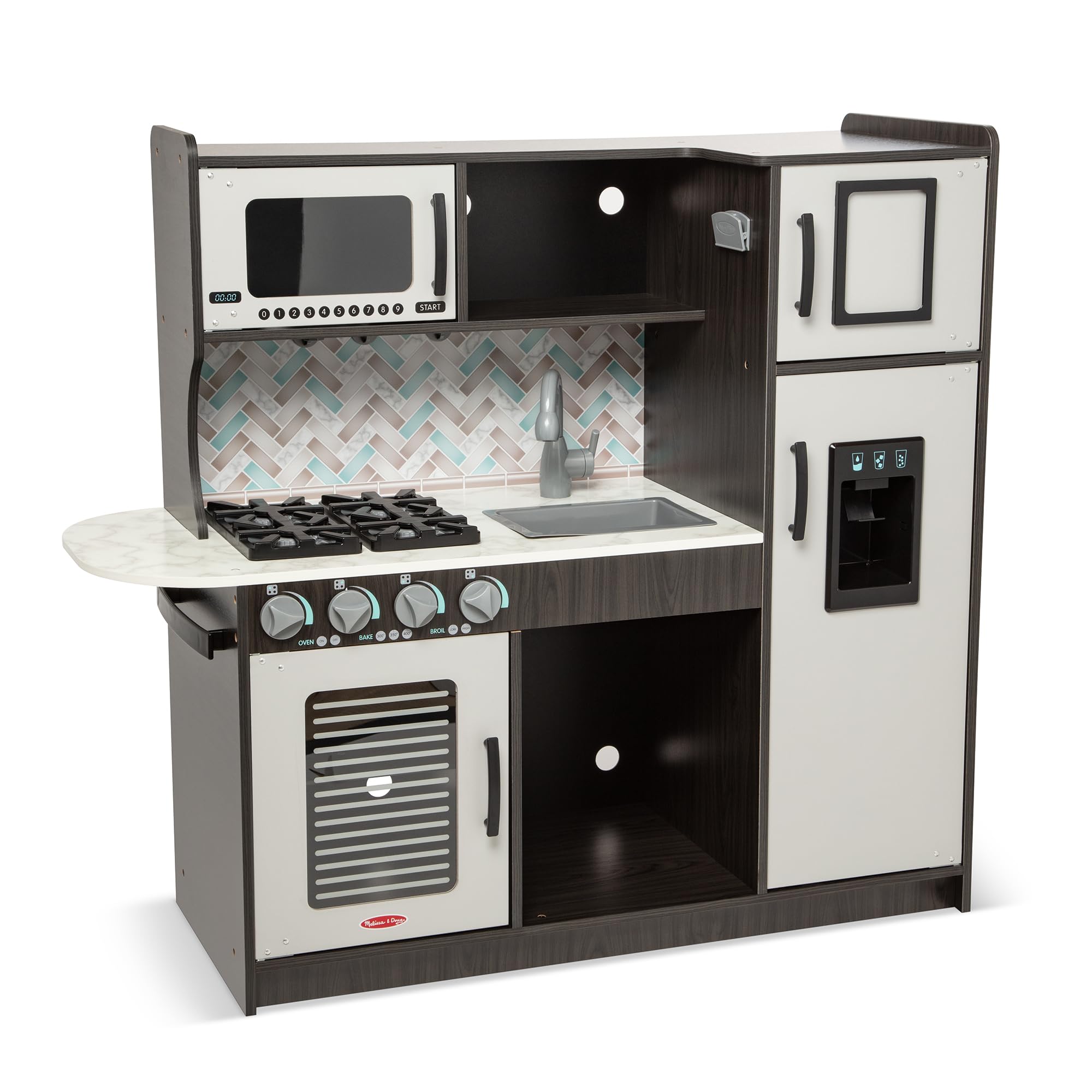
Melissa & Doug Wooden Chef's

Melissa & Doug Wooden Chef's

Living rooms

Doodle Score 9.2/10
Check Price

Worth Noting

  • 64.8 pounds; a two-person build
  • Door and hinge parts can break
Weight
64.8 lb
Material
Wood
Age Range
3 to 6 years
Play Features
Ice dispenser and spinning microwave
Read the full review

The ice dispenser is the first thing children find. Press the lever and two chunky ice cubes drop into the glass, and there's something about that small mechanical payoff that keeps a three-year-old at the fridge door long after the pans have been abandoned.

The rest of the set is just as thought through: a microwave plate that spins, dials that turn, handles that pull, movable hooks, and a grocery checklist for the shopping trip before the cooking. Oven, stove, microwave, sink and a refrigerator with the working dispenser make a full appliance line-up rather than a sink and a hob with an oven painted on.

Two practical notes. At 64.8 pounds it is by far the heaviest kitchen here, so it arrives as a two-person build and a two-person move, and it doesn't skate across the floor when a child leans on it. The instructions are the clearest in this group, which matters because durability is the weak spot: oven doors and hinges can break away, so check the door alignment as you build and don't over-tighten the fixings.

What it buys you is the best-looking wooden kitchen in this guide. The charcoal finish reads as furniture rather than toy, and it earns its place in a living room instead of being hidden in a playroom. That's the trade against the KidKraft Vintage: a sturdier build and a working ice maker for a much heavier, more expensive unit that stays where you put it.

Bottom line: Buy it for the ice dispenser, the clear instructions and the best finish here, and give it a permanent spot — it's too heavy to move and its hinges want watching.

#7

Tiny Land Adjustable Height

Tiny Land Adjustable Height

Growing kids

Doodle Score 9.0/10
Check Price

Worth Noting

  • Doors and sinks can crack or come loose
  • Assembly time varies a lot
Material
Wood
Assembled Size
38.5" H x 30.3" W x 11.8" D
Height Settings
Three positions
Included Accessories
18 pieces
Read the full review

Most play kitchens are outgrown in height before they're outgrown in interest. This one answers that with three height settings, so the counter comes up as the child does, and a kitchen bought for a third birthday can still fit at six.

The rest of the package is generous for the size: 18 pieces including cutting food, cookware, plates, utensils and a cup, plus a chef hat and apron for the cook, and lights and cooking sounds on the hob. At 30.3 inches wide and 11.8 inches deep it's the smallest wooden kitchen here, which makes it the easiest to slot into a bedroom without moving furniture.

It's wood, finished in soft white, and the listing claims both ASTM F963 and EN71 compliance. Assembly splits opinion — some builds come together quickly, others take ninety minutes and an electric screwdriver — so set aside an evening and don't start it late.

The thing to know is durability at the moving parts. Doors, sinks and stovetops have arrived cracked or come loose in use, and the faucet is the piece most likely to need gluing back. None of that stops the cooking, but a household with two rough children puts more strain on it than a single quiet one, and the plastic Step2s take that punishment better. If the height adjustment is the point for you, this is still the one to buy.

Bottom line: The pick for a wooden kitchen that follows a child from three to eight, provided you can live with a door or a faucet needing attention now and then.

#8

Little Tikes Super Chef

Little Tikes Super Chef

Tight budgets

Doodle Score 8.8/10
Check Price

Worth Noting

  • Screw holes may need drilling out
  • Legs and fittings feel flimsy
Material
Plastic
Assembled Size
40" H x 28" W x 14" D
Lights And Sounds
Burner cooking sounds
Included Accessories
Cookware, dishes, play phone
Read the full review

The cheapest kitchen here is also one of the narrowest: 28 inches wide and 14 deep, small enough for the end of a bedroom and cheap enough to say yes to without a spreadsheet. For a first kitchen in a small flat, that combination is hard to argue with.

You get more than the price suggests. A pan set down on the burner starts cooking sounds, the knob clicks, the microwave and oven doors work, and the cabinet opens onto storage. There's a chrome-look towel rail, and the box includes a coffee pot, frying pan, play phone, plates, cups and cutlery. The blue-and-cream finish is calm enough to leave out, which is not something every kitchen at this end of the market manages.

Build quality is where the money went missing. Screw holes can need drilling out, the legs bend if you force them, and the finished unit can sit top-heavy, so secure it to the wall before a child hangs off the oven door. Assembly is a chore rather than a pleasure. None of it stops the kitchen doing its job; it just means you'll want a drill, a free afternoon and a wall fixing.

Bottom line: A solid first kitchen for a tight room and a tight budget, as long as you own a drill and put a wall fixing in before the first play session.

How We Assembled, Wiped Down, and Play-Tested 12 Play Kitchens

We started with about 40 play kitchens from brands we'd happily recommend to a friend, then narrowed the list by price, footprint, style, and what a child actually gets to do with the thing. Twelve made the cut, and each one spent six months in a home with at least one child between the ages of 2 and 6.

The first hour with every kitchen was the same: we laid out the hardware and checked it against the parts list before turning a single screw. Three of the 12 were short something — usually a screw or a handle — which told us plenty about how carefully each box was packed. We built each one solo with a stopwatch running, flagged the steps where the instructions went vague or a panel was mislabeled, then rebuilt the fiddliest ones with a toddler "helping" the way it actually happens at home.

After that came the part that matters. We measured footprint and counter height against our own kids and noted whether two children could cook side by side without elbowing each other out of the way. We tracked which features earned their keep — knobs that turned, an ice dispenser that dropped cubes, a light that switched on — and which ones nobody touched after week two. Doors were opened and slammed, handles and hinges were leaned on, and every spill got wiped with a damp cloth. Once a month we checked for wobbly legs, lifting laminate, and stripped screws, because durability is what you're really paying for.

The kitchens that held up were the ones where nothing felt like an afterthought — the hardware, the instructions, and the finish all got the same attention as the cute stuff on the front. Those are the ones that made the list.

How to Choose

Measure the wall, not the photos

Assembled depth is the figure that decides whether a play kitchen works in your space, and it's the one listings bury. The plastic sets here run 11.5 to 16.75 inches deep; the wooden ones 11.8 to 13.23. Width varies far more, from 28 inches on the Little Tikes Super Chef to 45.13 on the Heart of the Home, which is why a narrow room usually wants a single-run kitchen rather than a corner unit.

One trap: compact in a listing often means smaller than the maker's other models, not small in your room. Measure the wall run, then leave a clear walkway beside it. A 45-inch kitchen in a 60-inch gap is a kitchen nobody can stand next to.

Wood or plastic, decided by the room

Plastic gets you lighter weight (the Step2 sets are 23.7 and 25 pounds), a wipe-clean surface, and less money. Wood gets you 35 to 65 pounds of stability, quieter doors, and something that reads as furniture rather than toy.

Our rule is the room, not the spec sheet: plastic for a bedroom, a playroom or a patio, wood for a room you have to sit in. The trade is your evening. A plastic Step2 goes together with a screwdriver; the wooden KidKraft and Melissa & Doug sets run to a long parts list and hours.

Height and the age you're really buying for

Counter height tracks overall height, and the kitchens here run from 34.92 inches on the KidKraft Vintage to 48 on the Heart of the Home. A three-year-old works comfortably in the lower part of that range; anything near four feet is a three-and-up kitchen whatever the box claims.

Treat an age range such as 2 to 10 as the safe-use window, not a prediction. Most children drift away around six, so buy for the next three years. If you want one purchase to stretch, the Tiny Land's three height settings are the feature worth paying for.

The evening you're actually buying

Most frustration in this category comes from assembly, not play. Expect screws driven into undrilled plastic on the Step2 sets, picture-only instructions and long parts lists on the wooden ones, and decals to apply by hand on nearly all of them. Build it the night before a birthday, with two people if it's wood.

Then look at storage. A kitchen whose parts have molded homes gets tidied up by the child rather than by you, and that is worth more day to day than three extra accessories in the box.

Frequently Asked Questions

Final Verdict

Start with the Step2 Fun with Friends. It's the kitchen most families can live with: 12.5 inches deep, storage molded for every one of its 25 accessories, a burner that lights and sizzles, and a midrange price that undercuts the wooden sets without giving up play value.

If two children cook at once, the Heart of the Home's 45-inch counter is the better buy. If the kitchen has to pass as furniture in a living room, build the KidKraft Vintage instead and give up an evening to do it.