Baby & Toddler

8 Best Busy Boards for Toddlers 2026: 8 Tested Picks

We tested wooden, felt, and light-up busy boards to find durable, travel-ready picks for fine motor play, plus the safety details to check.

The fantasy goes like this: you slide a busy board onto the table at a restaurant and your toddler stays happily occupied until the food arrives. The reality, with the first few I bought, was a trail of loose felt shapes under the booth and a latch that quit by week two. A busy board is really a small piece of engineering — buckles, zippers, latches, and Velcro sized for hands still learning to pinch — and whether it buys you 20 quiet minutes or becomes floor clutter comes down to how well those parts are built and attached.

That's the gap my team and I went looking for. We've had 12 busy boards in rotation for five months — living rooms, airplane tray tables, the back seat on the way to daycare — and the ones that held up share a few traits. My biggest piece of advice: piece count isn't play value. A board with six well-chosen elements keeps a 2-year-old busier than one with 20 flimsy ones, and the picks below run from boards for wobbly sitters to ones for kids who can finally work their own buckles.

#1

Melissa & Doug Hide & Seek

Melissa & Doug Hide & Seek

Durable wood play

Doodle Score 9.6/10
Check Price

Worth Noting

  • Pieces can sit tight in their cutouts
Doors
9 hinged doors
Material
Wood and magnets
Age Range
3+ years
Read the full review

Nine hinged doors, each hiding a wooden magnetic piece, is a simple idea, but the execution is why this Melissa & Doug board sets the pace for us. The 12.2 x 9.5-inch wooden frame feels substantial without being awkward to move from shelf to floor, and the magnetic pieces stay parked behind their doors rather than sliding around the room. For a child who likes to open and close things, that guess-lift-match-close loop is more satisfying than a page of printed prompts.

What makes it our default is the combination of durability and open-ended play. We treat this as the board that can live in a playroom rather than a diaper bag, and the wood-and-magnet construction is the reason: no stitching to fray, no Velcro to lose its grip, no battery door to babysit. It also grows with a child. A 3-year-old can work on color matching and vocabulary; an older sibling can turn it into a storytelling game. The 3+ age label is worth respecting, because the pieces are small enough to matter for a child still mouthing toys.

The board is deliberately plain compared with a light-and-switch panel, and that is part of the appeal. There is no volume, no flashing, and nothing to recharge; it comes out, gets played with, and goes back. The heft of the wood matters more than it sounds: the board stays put when a child leans on it, so the play stays focused on the doors rather than on chasing the toy across the table.

Bottom line: We think this is the best default for a durable, low-maintenance busy board: buy it for a 3-year-old who likes doors, magnets, and repeat play.
#2

Winblo Toddler Busy Board

Winblo Toddler Busy Board

Travel busy book

Doodle Score 9.4/10
Check Price

Worth Noting

  • Detachable pieces can lose grip and go missing
Pages
8 pages, 7 themes
Material
Soft felt
Activities
28 activities
Dimensions
11 x 8.6 x 1.5 inches
Read the full review

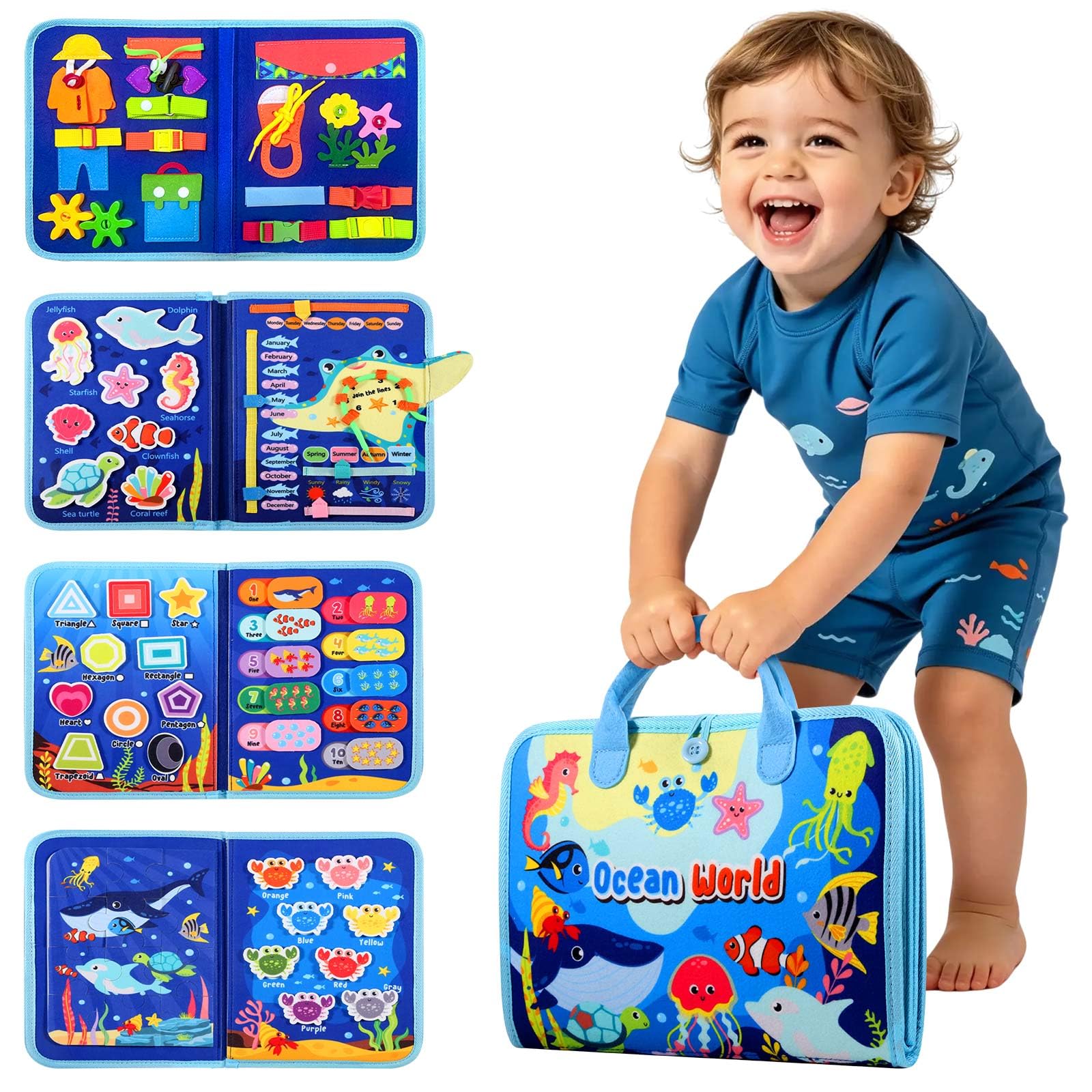
The Winblo is the one we reach for when the busy board has to leave the house. Its eight pages cover seven themes and 28 activities, all in soft felt, and the whole book measures 11 x 8.6 x 1.5 inches. For a first busy book, the combination is exactly right: quiet, soft-edged, and varied enough that a toddler can move from buckles to zippers to matching without the whole thing feeling like a single trick.

The activity mix is the reason it works. The pages are built around real fastenings and small challenges rather than passive pictures, which is what we want from a Montessori-style toy: something a child can try, fail at safely, and try again. The felt body keeps the weight down, so it fits in a diaper bag without becoming the heaviest thing in it. It is still a book, not a pocket toy; the 1.5-inch thickness means it takes up real space.

The 24-month lower age limit is more useful than the 8-year upper end; this is a toddler toy, and older children will move on. We also like that it does not need batteries or make noise, which makes it a better restaurant and waiting-room companion than the light-up boards here. The felt pages are soft enough to flip without sharp edges, and the whole thing packs flat enough for a bag.

Bottom line: We recommend it as the travel-first busy book: light, quiet, and packed with enough pages to rotate through a restaurant wait.

#3

VTech Latches and Doors

VTech Latches and Doors

Early latch play

Doodle Score 9.4/10
Check Price

Worth Noting

  • Sound and light functions can stop working
  • Some doors are stiff for small hands
Modes
Learning and music
Controls
Latches, switches, and key
Age Range
12-36 months
Batteries
2 AA batteries
Read the full review

For a 1-year-old who wants the real door, the real latch, and the real key rather than a felt page, the VTech is the most direct fit. It is a plastic house-shaped board with moving latches, switches, a key, and doors that reveal family members and pets. The learning mode names numbers 1-5, while the music mode adds songs and sound effects. It is a battery toy, and it behaves like one.

The appeal is the physical sequence: slide, lift, turn, open. That is the kind of fine-motor practice a toddler can transfer to the front door or the car, and the board gives it a safe, repeatable shape. The three colorful buttons add a second layer of cause and effect, and the plastic body wipes clean after snack hands. At 14.2 x 11.6 x 2.7 inches, it is a tabletop toy rather than a bag toy; it needs a lap or a low table.

We rate it as the strongest 12-36 month option here for latch-and-door play. The plastic construction is easy to live with, but this is not the board to buy if you want a silent, battery-free toy for a restaurant. It is the one for a child who is already reaching for the baby gate, the cabinet lock, and the light switch.

Bottom line: We think it is the best choice for a 12-36 month old who loves real latches and doors, provided you can live with battery-powered sounds.

#4

TINTECUSA Wooden LED Busy Board

TINTECUSA Wooden LED Busy Board

Budget light play

Doodle Score 9.2/10
Check Price

Worth Noting

  • No master power switch
  • Some switches are stiff for small hands
Power
2 AA batteries
Lights
12 LED lights
Controls
12 buttons and switches
Dimensions
6.9 x 5.9 x 1.1 inches
Read the full review

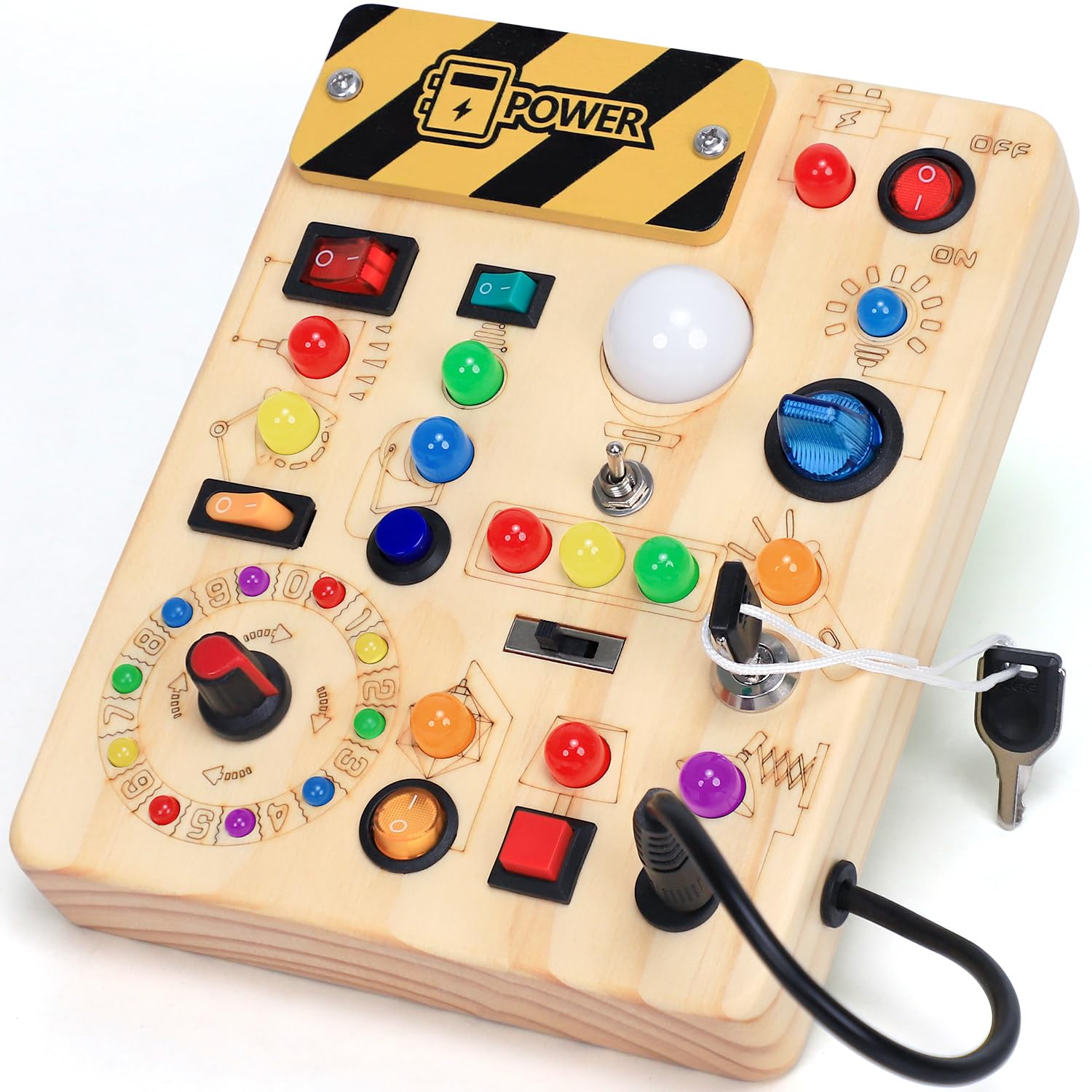
The TINTECUSA is the value play in this set: a small wooden board with 12 LED lights, 12 buttons, knob switches, plugs, and a mirror. At 6.9 x 5.9 x 1.1 inches and 200 grams, it is a lap or car-seat toy rather than a floor board. That is not a compromise if you want something a toddler can carry; it is the point.

What earns it a recommendation is the density of cause and effect. Press a button, turn a knob, plug a cord, and something lights up; the mirror adds a second kind of discovery. The wooden body feels more substantial than the plastic alternatives, and the controls are varied enough to keep a child working through different grips. We treat it as the board to buy when you want light-switch play without spending much.

The small size is the honest limitation: it fits in a diaper bag, but it will not fill a playroom the way a larger latch board does. That makes it a second toy rather than a whole play station, which is exactly how we use it. The range of switches is the part that keeps it interesting after the first day.

Bottom line: We recommend it as the budget light board: it gives a toddler plenty of cause-and-effect switches for the least money here.

#5

SaFeli 12-Page Busy Board

SaFeli 12-Page Busy Board

Space-themed pages

Doodle Score 9.2/10
Check Price

Worth Noting

  • Velcro pieces can stop sticking
Pages
12 interactive pages
Material
Soft felt
Age Range
3+ years
Dimensions
11.3 x 8.2 x 2.3 inches
Read the full review

Twelve pages is the headline, and it is the reason the SaFeli earns a place over the smaller felt books. The space theme gives each spread a different scene, so a child who burns through a four-page book has more to rotate through. At 11.3 x 8.2 x 2.3 inches, it is still a bag book, but it is the roomier end of travel busy boards.

The page count matters because variety is what keeps a felt book in use. Zippers, shapes, and matching activities give a toddler different grips and different problems to solve, and the soft felt body keeps the whole thing quiet and packable. The space theme is also a nice change from the pink-and-unicorn default; it gives a 3- or 4-year-old something to talk about while they work.

This is not the first busy book for a 1-year-old. The 3+ age label and the small pieces put it past the mouthing stage, and the 2.3-inch thickness means it takes real space in a bag. What it does well is give an older toddler more pages to grow into, especially one who has already worked through a smaller book. The space theme is the part that keeps it from feeling like another generic felt book, and that matters when you are packing the same bag every week.

Bottom line: We recommend it for the child who needs more pages than a standard eight-page book, especially if space and planets are the hook.

#6

RichBoy 37-in-1 Busy Board

RichBoy 37-in-1 Busy Board

Maximum switch variety

Doodle Score 9.2/10
Check Price

Worth Noting

  • Some switches can stop working
Lights
24 LED lights
Switches
13 switches
Activities
37-in-1
Battery Lock
Tool-operated child lock
Read the full review

37-in-1 is a big claim for a board that measures 6.7 x 5.3 x 1.2 inches, but that is exactly the appeal: RichBoy packs 24 LEDs and 13 switches into a palm-size wooden frame. The light show includes a larger 25mm gradient bulb as well as 13mm LEDs, so the panel has more visual range than a row of identical dots.

The battery compartment has a tool-operated child lock, which we appreciate on a toy that is meant to be handled constantly. The board is made from natural wood with rounded, sanded edges, and the controls are crowded in the way a good fidget board should be: plenty to touch without much wasted surface. It is the kind of toy that invites a child to work across the panel rather than finish one task and walk away.

The density is also the reason it is not the first board for every toddler. A 1-year-old who is still learning to press a single button may find 13 switches overwhelming, and some of the key and wire controls take more control than the rest. It is better as a second board, once a child has the hang of push-and-turn play.

We rate it as the best board here for maximum switch variety in a small frame. The tool-locked battery door is the detail that makes it feel more considered than the price suggests, and it is the one we choose for a child who has already worn out a simpler light board.

Bottom line: We recommend it for the switch-obsessed toddler who has already tried a simpler light board and wants a denser panel.

#7

HarVow LED Switch Board

HarVow LED Switch Board

Bag-size light play

Doodle Score 9.0/10
Check Price

Worth Noting

  • Lights or switches can fail over time
Power
2 AAA batteries
Lights
24 LED lights
Material
Solid natural wood
Switches
13 switches
Read the full review

The HarVow is the compact light board we keep coming back to for bag carry: 13 switches and 24 LEDs in a wooden body small enough for a toddler to hold. It is not trying to be a whole play table. It is trying to be the thing you hand over in a waiting room, and at roughly palm-plus size, it does that job.

The switch variety is the draw. Each control triggers different colors and patterns, so there is more to discover than a single on-off button, and the solid natural wood body has hand-sanded edges rather than a veneer shell. For a child who likes cause and effect, that density is worth more than a larger board with fewer controls. It is also a board that invites repeat visits because the combinations are not all visible at a glance.

We rate it as the strongest compact LED alternative here for a child who wants more switches than the budget TINTECUSA offers. The size is the catch for some: this is a pocket board, not a floor toy, and a child who wants to spread out will do better with the VTech or a larger latch board. For travel and small hands, the trade-off is worth it.

Bottom line: We recommend it for travel and small hands: a dense light-switch board that fits in a bag and keeps cause-and-effect play going.

#8

hahaland 8-Page Busy Board

hahaland 8-Page Busy Board

Letters and numbers

Doodle Score 9.0/10
Check Price

Worth Noting

  • Requires attaching many Velcro pieces first
  • Velcro pieces can lose their grip
Pages
8 pages
Format
Removable zipper pages
Life Skills
15 sensory toys
Cognitive Boards
6 boards
Read the full review

The hahaland book is the most school-ready of the felt busy boards here: eight pages, 15 life-skill sensory toys, and six cognitive boards covering letters, numbers, colors, shapes, animals, and weather. It looks like a preschool workbook that got soft, and that is meant as praise. The handle and removable zipper pages make it feel like a little suitcase rather than a stack of fabric.

The cognitive boards are the differentiator. A child can work on 26 letters, 10 numbers, 10 colors, 12 shapes, 11 animals, and 9 weather parts in the same book that teaches buckles, snaps, buttons, and tying. That breadth is useful for a 3- to 5-year-old who is starting to notice letters and weather, and it gives the book more staying power than a pure dressing-skills board.

The 11 x 9-inch size and felt body keep it portable, and the removable pages let you take one board instead of the whole book. We like that for appointments and restaurant waits, where a single page can be enough. It is also the busiest-looking book in this set; there is a lot to notice on every spread, which is either the appeal or the distraction depending on the child.

We rate it as the strongest choice here for letter, number, and weather practice in a felt book. It suits a 3- to 5-year-old who is ready for that kind of focused matching, and the removable pages are the part we appreciate most because they let you pack lighter without giving up the variety.

Bottom line: We recommend it for the family who wants letters, numbers, and weather practice in one felt book, especially a 3- to 5-year-old.

How We Chose and Tested the Best Busy Boards

We started with a list of about 40 boards — the ones that dominate search results, the ones parents recommend in forum threads, and a handful from small woodworking shops — then cut it down by age labeling, element mix, and whether the loose pieces were tethered to the board or had their own storage. That left 12, from simple six-element boards to big folding ones.

Testing happened where busy boards actually live: on the living room floor during the pre-dinner fussy hour, on a restaurant table while we waited for food, on a lap in a car seat, and on an airplane tray table. One tester, a toddler-room teacher, brought two boards into her classroom for a week of use by nine kids between 12 months and 3 years, which is the closest thing to a stress test we could arrange.

Every board got the same handling. We peeled and re-stuck each Velcro piece 50 times to see whether the hook side went fuzzy or kept its grip, then carried the board by its handle, shook it, and counted how many pieces were still attached. We worked every zipper, buckle, snap, switch, and latch with adult hands and with kids' hands, noting which ones split, jammed, or demanded more strength than a 2-year-old has. Boards were dropped off a counter, stood on, wiped with a damp cloth, and inevitably chewed.

We also measured each footprint, weighed it, and checked whether it fit in a diaper bag, since a board too big to bring is a board that stays home. Finally, we tracked which elements each age group returned to on the second and third day — 1-year-olds gravitated to latches and crinkly bits, 3-year-olds parked themselves at the buckles — which told us more about staying power than any box copy could.

How to Choose

Match the Board to the Child, Not the Age Range Alone

A board with real latches and a key suits a 12- to 36-month-old who is learning to push, turn, and open. A wooden door-and-magnet board is better once a child is past mouthing pieces. The age range is the start of the decision, not a guarantee. We treat the lower end as the more useful number: a board labeled 3+ is usually a poor fit for a 2-year-old who still tests everything in their mouth, while a 12-36 month electronic board is outgrown sooner. Choose the stage first, then the theme.

Decide Between Pages, Switches, or Both

Felt page books and light-and-switch boards build different kinds of attention. A page book is for quiet, varied pretend-play: buckles, zippers, shapes, and matching that a child can move through at their own pace. A switch board is for cause and effect, with a tighter loop of press, turn, and light. We favor a page book for waiting rooms and a switch board for a child who needs a physical reaction. If you are choosing one, pick the kind of play your child already seeks out.

Piece Retention Is the Quiet Dealbreaker

A busy board with 30 detachable pieces is only useful if those pieces stay where they belong. Velcro is the usual weak point in felt books: it can lose grip, collect lint, and send small parts under the car seat. We treat piece retention as a bigger deal than page count, because a book that sheds pieces becomes a cleanup job. Choose a board with attached fastenings or magnetic pieces if you want less managing, and plan a pouch for any loose parts.

Travel Size Is Not the Same as Small

A 6.7-inch wooden board is a lap toy; an 11 x 9-inch felt book fits a diaper bag but not a pocket. Check the largest dimension against the bag you actually carry, not just the word compact. Noise and power matter too: a battery board needs the right batteries and can be left on, while a felt book is silent but may need a piece pouch. For a flight, we favor a quiet board with no loose pieces; for a car seat, a compact light board is easier to hand back.

Check the Build and the Battery Door

Wood, felt, and plastic all survive different kinds of toddlers. Wood is the most drop-resistant and the easiest to wipe, but hinges and doors need smooth edges and secure screws. Felt is soft and quiet, but stitching and Velcro are the wear points. Plastic is easy to clean, though battery doors and sound modules are the parts that fail. On any light-up board, check that the battery compartment locks and that the controls are sized for a toddler's fingers.

Frequently Asked Questions

Final Verdict

Start with the Melissa & Doug Hide & Seek Activity Board. It is the one we trust as a long-term playroom board: wooden, magnetic, and free of the Velcro-piece scramble that defines so many felt books. It asks for a child past the mouthing stage, so the 3+ label matters. If you need a bag-size book for a younger toddler, the Winblo is the better fit. If your child wants lights, choose the TINTECUSA for value or the RichBoy for switch variety.