Baby & Toddler

12 Best Teaching Clock for Kids 2026: Activity Sets Teach Time

Which teaching clocks actually help kids learn to tell time through play and practice, and which ones just sit on the wall.

Teaching clocks often leave parents frustrated: stiff hands that children cannot turn independently, quartz movements that stop after a few months, or numbered pieces that fall out of wooden puzzles. Many designs look good in photos but fail under daily use with an active child.

The most effective learning tools give kids something to manipulate - a demonstration clock with geared hands, games that reinforce concepts, or a wall clock with color-coded sections for daily reference. Activity-based sets provide structured lessons, while a silent wall clock offers passive practice. The two approaches complement each other, and most families benefit from having both.

This guide identifies teaching clocks that actually work, prioritizing durability, clarity, and genuine learning value. The right choice depends on your child's age and learning style - a toddler needs a different tool than a first grader learning quarter past and half past. Understanding the real-world trade-offs, such as geared versus independent hands or plastic versus wood, helps select a clock your child can actually use.

#1

Learning Resources Time Activity Set
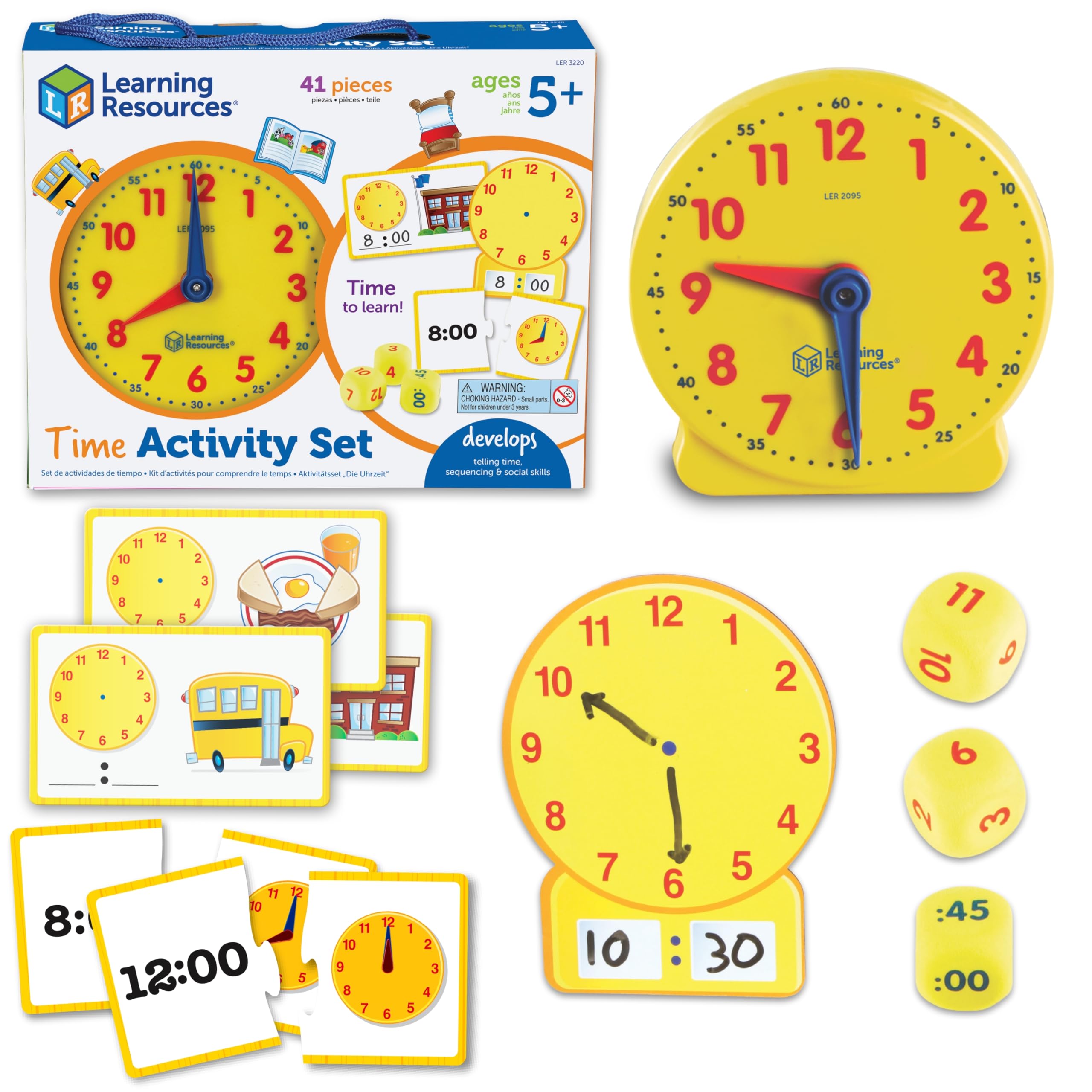
Learning Resources Time Activity Set

Complete learning system

Doodle Score 9.6/10
Check Price

Worth Noting

  • Geared hands only rotate clockwise, making it slower to set specific times by moving backward
  • Under rough handling, the clock or stand may show wear faster than expected
Size
10 inch demonstration clock
Type
Activity set with demo clock
Age Range
5+ years
Special Features
Geared hands, no batteries
Read the full review

The Learning Resources Time Activity Set bundles a demonstration clock, write-and-wipe clock, 24 double-sided activity cards, puzzles, and dice into one kit — everything a parent or teacher needs to introduce time-telling through varied, engaging play. The geared movement correctly shows how the hour hand advances as the minute hand moves, reinforcing the relationship without batteries or electronics.

Kids respond well to the game-like format: rolling dice to set times, matching puzzle pieces, and using the cards for self-directed practice. The kit works best as an active teaching tool alongside an adult, not as a silent wall clock for daily reference. One design tradeoff is the geared mechanism that only rotates clockwise — setting it backward to a specific time requires turning the minute hand forward around the full circle, which can slow down quick demonstrations.

This set suits children ages 5 to 7 who are ready to learn analog time through guided, participatory activities. Homeschoolers and classroom teachers will get the most value from the reusable write-and-wipe clock and the variety of card games. It's less ideal for toddlers under 4 due to small parts, or for anyone seeking a passive wall clock for everyday time-checking.

Tip: To quickly set a time, always rotate the minute hand clockwise through the full circle — skipping backward isn't possible with this geared movement.

Bottom line: For families and educators who want an interactive, all-in-one learning system rather than a standalone wall clock, this kit delivers exceptional value and effective results.
#2

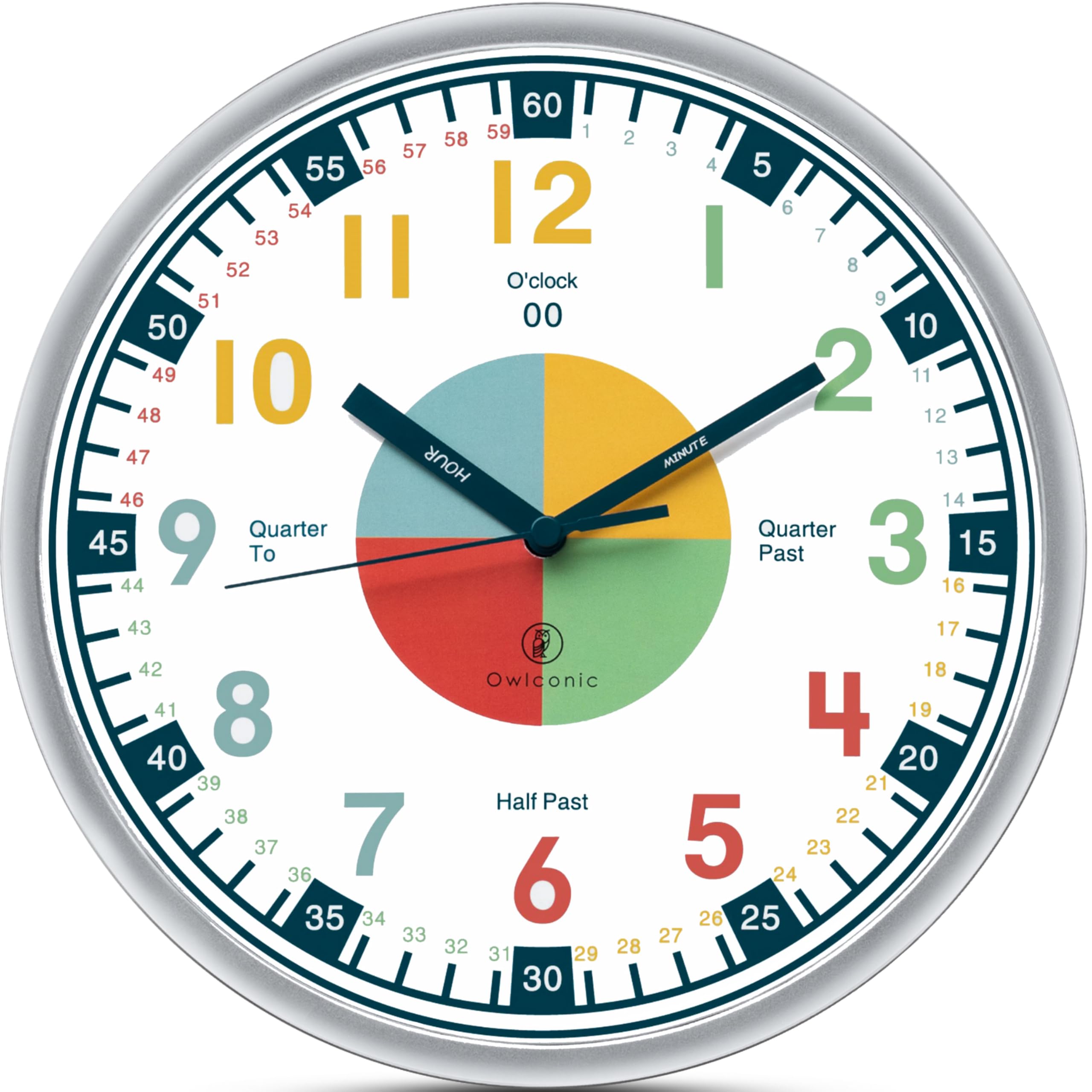
OWLCONIC Educational Wall Clock

OWLCONIC Educational Wall Clock

Color-coded wall clock

Doodle Score 9.6/10
Check Price

Worth Noting

  • Plastic face cover can create glare under bright lighting, reducing readability.
  • Battery life varies and the clock lacks a night light or digital display.
Size
10 inches diameter
Type
Analog wall clock, silent sweep
Age Range
4-18 years
Special Features
Color-coded sections, silent sweep
Read the full review

The OWLCONIC clock uses a silent sweep movement and color-coded sections (quarter past, half past, quarter to) to make time-telling intuitive without any active participation. Unlike an activity set that requires hands-on practice, this clock provides continuous passive exposure – children absorb the visual pattern simply by glancing at it throughout the day.

Best for parents of children ages 5–8 who want a functional wall clock that reinforces time concepts in everyday settings like bedrooms or homeschool rooms. The acrylic face can produce glare in bright rooms, and the clock relies on battery power with no night light, so it suits homes where you can control light conditions and replace batteries every few months. This is not a hands-on demo tool – it delivers daily visual repetition in a attractive, quiet package.

Tip: Position the clock away from direct sunlight or bright lamps to minimize glare on the acrylic cover.

Bottom line: If you want a daily visual aid that runs silently and looks good on the wall, this is a smart buy. For families that also need hands-on practice, pair it with the top-pick activity set.

#3

Melissa & Doug Shape Sorting Clock

Melissa & Doug Shape Sorting Clock

Toddler shape-sorter

Doodle Score 9.6/10
Check Price

Worth Noting

  • Wood finish may develop minor splintering or chipping after extended play.
Size
9 x 9 x 4.5 inches
Type
Wooden shape-sorting puzzle clock
Age Range
3+ years
Special Features
12 removable shaped pieces
Read the full review

This wooden clock stands out for its sturdy construction and ability to teach multiple early learning skills. Unlike comprehensive activity sets that focus solely on time-telling, this toy layers shape sorting and number recognition into the same hands-on experience, making it a natural fit for younger children who aren't ready for a dedicated clock.

Best for toddlers and preschoolers (ages 2-4) who benefit from multi-skill play. The numbered pieces can fall out when the clock is tilted, so it's better for stationary play on a table than for carrying around. Parents seeking a durable wooden toy that grows with the child from shape sorting to basic time telling will find value here.

Tip: Keep the clock on a flat surface during play to prevent numbered pieces from scattering.

Bottom line: A solid entry-level toy for toddlers that combines multiple learning areas, best for stationary play.

#4

Oyster&Pop Teaching Wall Clock

Oyster&Pop Teaching Wall Clock

Rainbow teaching clock

Doodle Score 9.4/10
Check Price

Worth Noting

  • Some units may arrive without function, requiring a return.
  • Accuracy may drift after several months of use for some clocks.
Size
10 inches diameter
Type
Analog wall clock, rainbow color-coded
Age Range
5+ years
Special Features
Color-coded rainbow sections, ebook
Read the full review

This rainbow-themed clock uses color-coded sections and large numbers to make time-telling intuitive for young learners, and the included ebook adds extra practice material. However, unit-to-unit consistency varies: some clocks may lose accuracy over months, and a small number arrive without working. For families wanting a decorative teaching clock that encourages daily time exposure, it works well, but those needing a more dependable long-term wall clock should consider the OWLCONIC alternative.

Bottom line: This clock suits families who want a colorful learning aid that blends into a child's room decor and don't mind occasional unit variance. For a more consistent long-term teaching clock, the OWLCONIC is a safer bet.

#5

Coogam Wooden Shape Sorting Clock

Coogam Wooden Shape Sorting Clock

Wooden Montessori toy

Doodle Score 9.4/10
Check Price

Worth Noting

  • Number blocks can slide out of their slots when the clock is moved, requiring reassembly.
Size
8.43 inches diameter
Type
Wooden puzzle clock with blocks
Age Range
3+ years
Special Features
12 removable blocks, movable hands
Read the full review

This wooden clock offers a solid construction and water-based finish, making it a safe choice for teaching colors, shapes, numbers, and beginning time concepts. Its colorful design and removable blocks keep young children engaged. However, the numbered pieces are smaller than those on comparable Melissa & Doug sets, creating a choking risk for children under 3 – so active supervision is required for the intended 3-5 age group.

Tip: Keep the clock flat on a table during play to prevent pieces from scattering.

Bottom line: Best for families who want a wooden activity toy that introduces time-telling gradually, provided the child is past the mouthing stage and play is supervised.

#6

Judy Clock (Carson Dellosa)

Judy Clock (Carson Dellosa)

Classroom demonstration clock

Doodle Score 9.4/10
Check Price

Worth Noting

  • Some units may have misaligned hands that don't move in sync.
  • Cardboard and particle board build may show wear under frequent use.
Size
13.5 x 13.5 inches
Type
Large demonstration clock, geared
Age Range
4-8 years
Special Features
Color-coded hands, adjustable stand
Read the full review

The Judy Clock's large 13.5-inch face and color-coded geared hands make it a standard for classroom demonstrations, helping groups see minute-hour relationships. However, the heavy cardboard build feels light for the premium price, and some units may arrive with misaligned hands that don't track correctly. This classic design still works for teachers who prioritize brand familiarity and group visibility over durability, but families seeking a rugged individual clock should look at the Learning Resources activity set.

Bottom line: Best for teachers who want a classic demonstration clock and don't mind occasional assembly issues or lighter build quality.

#7

Roymnie 8" Teaching Clock

Roymnie 8" Teaching Clock

Budget secondary clock

Doodle Score 9.4/10
Check Price

Worth Noting

  • 8-inch display may be too small for larger rooms or group viewing
  • A portion of units can stop working within days or months of use
Size
8 inches diameter
Type
Analog wall clock, colorful markers
Age Range
Not specified
Special Features
Colorful hour markers, sweep second hand
Read the full review

The Roymnie 8-inch teaching clock combines a colorful, easy-to-read face with silent sweep movement at a budget price. Its clear labeling helps children practice time-telling. However, the small 8-inch size is better suited for a child's desk or secondary room rather than a large classroom wall, and some units may stop working after a short period. This makes it a reasonable choice for light-duty or temporary use, but not a dependable primary teaching clock.

Bottom line: This clock works best as a secondary teaching aid in a child's bedroom or playroom, where its low price and cute design outweigh the risk of early failure.

#8

Melissa & Doug Turn & Tell Clock

Melissa & Doug Turn & Tell Clock

Self-checking wooden clock

Doodle Score 9.2/10
Check Price

Worth Noting

  • Clock hands require significant force to turn, especially the hour hand counterclockwise
  • Digital display rounds to the nearest 5 minutes, limiting practice to hour and half-hour increments
Size
9.45 x 9.45 x 4.72 inches
Type
Wooden clock with digital display
Age Range
4-7 years
Special Features
Self-checking digital display
Read the full review

The hidden digital display turns time-telling into a puzzle with instant feedback – kids set the analog hands, slide the window, and see if they matched the card. This mechanism encourages repeated practice without an adult hovering, which is a clear step forward from the shape-sorting clocks that only introduce time as one of many skills.

This clock suits children ages 4–7 who benefit from immediate self-verification and parents who prefer wood construction over plastic. However, the hands are very stiff to turn, especially the hour hand backwards – some kids will need help moving the hands, which undercuts the independent learning goal. The digital display also shows time only in 5-minute increments, so it works best for hour and half-hour practice rather than precise minute work.

Tip: Gently rotate both hands a few times before the first use – the stiffness may loosen slightly over time.

Bottom line: This clock works well for self-motivated learners who can handle some hand resistance – it’s less suited for children who need a friction-free experience.

#9

Learning Resources Big Time Student Clock

Learning Resources Big Time Student Clock

Individual home tutoring

Doodle Score 9.2/10
Check Price

Worth Noting

  • Compact size can be too small for group demonstrations or wall mounting.
  • Stand may detach if moved frequently or handled roughly.
Size
5.9 x 5.1 x 1.4 inches
Type
Desk demonstration clock, geared
Age Range
4-9 years
Special Features
Hidden gear mechanism
Read the full review

The geared movement shows how hour and minute hands connect, making time concepts click for ages 5+. At a budget-friendly price, it works well for one-on-one tutoring. Its compact size and stand that can detach under pressure mean it's less suited for group instruction or frequent moving – better as a personal practice tool.

Bottom line: Best for individual practice at home or in small tutoring settings where portability and stand fragility aren't dealbreakers.

#10

Torlam Magnetic Dry Erase Clock

Torlam Magnetic Dry Erase Clock

Magnetic whiteboard clock

Doodle Score 9.2/10
Check Price

Worth Noting

  • Magnets can detach from the board with repeated use.
  • Cardboard surface may warp in humid conditions or after heavy handling.
Size
12 x 12 inches
Type
Magnetic dry-erase demonstration clock
Age Range
6-8 years
Special Features
Magnetic, write/wipe surface
Read the full review

The Torlam clock's magnetic backing sticks to whiteboards, and the write/wipe surface allows repeated practice. However, the magnets can detach over time, the cardboard base may warp with handling, and the hands need a flat surface to stay in place — they don't hold position when upright. For quick whiteboard activities at a low price, it gets the job done.

Bottom line: Best for budget-conscious classrooms where the clock stays on a whiteboard for demonstration rather than being handled repeatedly.

#11

AIRUIFU Colorful Wall Clock

AIRUIFU Colorful Wall Clock

Ultra-budget wall clock

Doodle Score 9.2/10
Check Price

Worth Noting

  • Some clocks may stop working within months or arrive non-functional.
  • Plastic frame may crack, and hands can detach over time.
Size
10 inches diameter
Type
Analog wall clock, silent sweep
Age Range
3+ from reviews
Special Features
Color-coded hour sections, labeled hands
Read the full review

The AIRUIFU wall clock offers clear color-coded sections that make learning to tell time intuitive, with a vibrant design that appeals to kids. However, some units may stop working within months or arrive with issues like cracked frames or detached hands, and timekeeping accuracy can drift over time. This makes it best for temporary use, very tight budgets, or bulk purchases for classrooms where occasional replacement is acceptable.

Bottom line: This clock works for short-term learning needs or as a low-cost classroom set where occasional replacement is acceptable.

#12

Learning Resources Mini Clock

Learning Resources Mini Clock

Student desk practice

Doodle Score 9.0/10
Check Price

Worth Noting

  • Hands can be tough to turn when moving them backwards due to the geared mechanism
  • Plastic stand may detach during handling, especially on uneven surfaces
Size
4 inches diameter
Type
Mini desk clock with geared hands
Age Range
5+ years
Special Features
Hidden gears, color-coded markings
Read the full review

The Learning Resources Big Time Mini Clock packs geared hands that show the hour/minute relationship into a compact 4-inch body, making it easy to assign one to each student for desk-side practice. The geared mechanism keeps the hands connected, so turning the minute hand moves the hour hand correctly — a solid teaching tool for individual work.

This clock suits homeschoolers or budget-conscious classrooms that can buy multiple units without straining the budget. The small size is actually an advantage for solo use, fitting into a pencil case or sitting on a desk without taking over. However, the removable stand can detach with rough handling, and the geared hands resist backward movement — not an issue if you always set time clockwise. For group demonstrations, the 4-inch face is too small to see from across the room, so keep this one for one-on-one or small-group practice.

Tip: For stable use, place the clock flat on a desk instead of relying on the stand; it stays put on a flat surface.

Bottom line: A capable individual practice clock that works best when each child has their own — skip it if you need a front-of-room demonstration tool.

How to Choose

Type: Standalone Clock vs. Activity Set

A standalone wall clock offers daily passive reinforcement, while an activity set with cards, dice, and a demonstration clock enables active, hands-on learning. The trade-off: activity sets include more pieces that can get lost, but they provide structured lessons that accelerate understanding. For most families, a combination of both types works best.

Size and Visibility

Size directly impacts usability. A wall clock should be at least 10 inches in diameter for easy reading from across the room. Smaller demonstration clocks (4-6 inches) are only suitable for individual desk use, not for group instruction. Also consider material: glass faces can shatter if knocked, making acrylic a safer choice for kids' rooms.

Age Range

Age dictates which features matter. For toddlers aged 2-4, shape-sorting clocks that teach numbers and colors are more appropriate than precise time-telling. Ages 5-7 benefit from geared demonstration clocks where the hour hand moves with the minute hand, showing the proportional relationship. Older children (7+) can use self-checking clocks or wall clocks with detailed minute markings.

Special Features

Silent sweep movement is essential for bedrooms - any ticking noise can distract sleep. Write/wipe surfaces let children practice repeatedly without waste. Magnetic backing allows the clock to be displayed on whiteboards for classroom use. Interactive audio quizzes engage tech-savvy kids, but these electronic features add failure points; battery-powered teaching toys often stop working within months.

Build Material

Wood is durable and gives a premium feel, but cheaper wood clocks can splinter. Plastic is lightweight and affordable but prone to cracking under rough handling. Laminated cardboard is the least expensive option but warps quickly in humid environments or with heavy use. Choose material based on the child's age and how roughly the clock will be handled.

Frequently Asked Questions