Pretend Play

9 Best Puppet Theaters of 2026: Tested and Ranked

We tested puppet theaters for kids and picked the sturdiest floor stage, the best doorway space-saver, a tabletop pick, and a pop-up for tight budgets.

Puppet theaters are one of the few toys that turn a living room into a stage and a quiet kid into a storyteller. The trouble is that plenty of them look enchanting in photos but arrive as a flimsy stack of panels, a bag of unfamiliar screws, or a stage that wobbles the second a dragon makes its entrance. A good one should set up without a fight, stand steady through repeated shows, and look tidy enough to leave out between performances.

Over the past seven months, my team and I have assembled and lived with nine puppet theaters, from tabletop models to floor-standing stages. We watched kids ages four to eight put on after-school shows and weekend playdates, and we paid attention to the things that actually wear out: curtain rods, hinges, seams, and patience during assembly. We also measured footprints and stage openings, checked every parts bag before building, and noted which theaters got dragged back out for a second show — and whether the materials justified the price.

#1

Puppedcation Tripod Puppet Stage

Puppedcation Tripod Puppet Stage

Classrooms and groups

Doodle Score 9.6/10
Check Price

Worth Noting

  • Not a kids' play stage; listed 8 and up
Includes
2 tripods, crossbar, curtain, carry case
Size Range
88.5 x 59 in (max), 59 x 27 in (min)
Recommended Age
8 years and up
Read the full review

This isn't a playroom toy, and it doesn't pretend to be one. Puppedcation sells a tripod stage — two stands, a crossbar, a curtain, and a carry bag — sized from 59 x 27 inches at its smallest up to 88.5 x 59 inches, and it is aimed at classrooms, camps, and ministry groups rather than bedrooms.

Judged as a portable stage, it is the most capable thing on this page. It sets up in minutes, the curtain is opaque rather than see-through, and an adult can stand behind it — which none of the wooden theaters here allow. If you are running a story hour for a room of children, this is what you want, and the bag means it lives in the back of a car between bookings.

For a family, the mismatch is obvious. It is a frame and a curtain with nothing at floor level for a small child to lean on or hide behind, and an 88-inch stage will swallow a lone five-year-old. The listing also puts it at eight and up, which is honest. Buy it for a group that performs standing up, and buy one of the wooden stages for the child who performs from the rug.

Bottom line: For classrooms, camps, and church groups rather than bedrooms: a real portable stage that packs into a bag and stands tall enough for adults.
#2

Melissa & Doug Deluxe Puppet Theater

Melissa & Doug Deluxe Puppet Theater

Family playrooms

Doodle Score 9.4/10
Check Price

Worth Noting

  • Needs adult assembly with a screwdriver
  • No puppets included in the box
Weight
12.3 lb
Stage Details
Plush curtains, clock, chalkboard
Assembled Size
66 x 132 x 46 cm
Recommended Age
3 to 12 years
Read the full review

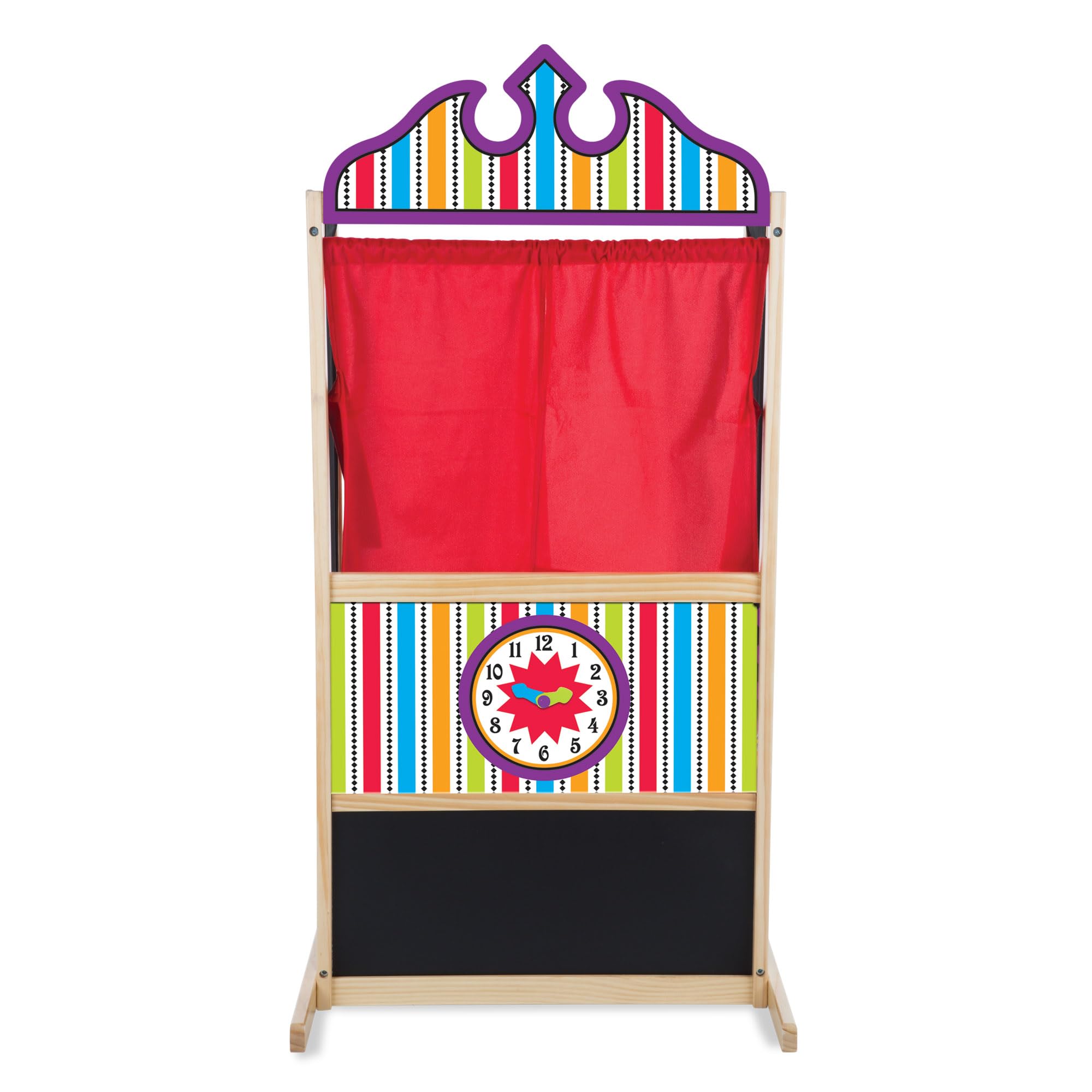
Most puppet theaters fail in the same place — the base. A stage gets leaned on, crawled behind, and dragged across the rug mid-scene, and a narrow footprint goes over. The Melissa & Doug Deluxe is the one here we trust through all of that: a non-tip base, 12.3 pounds of wood holding it down, and 132 cm of assembled width, which is about 52 inches across and enough for two children to sit behind without elbowing each other.

The details are why it stays in the room. The curtain is plush rather than a printed sheet, the clock has hands that move, and the chalkboard sits at a child's height, which is exactly where the show announcements belong. In a toy that lives in the middle of everything, that matters more than it sounds: the board and clock give kids a job in the ten minutes before the show, and the curtain gives them a reveal.

Two things to plan for. It arrives flat and needs an adult with a screwdriver, and once it's up it's furniture, so give it a corner rather than a slot in the toy bin. Puppets aren't in the box either — you'll want two hand puppets alongside it. The opening is also built for children; an adult sitting behind 26 inches of stage will be cramped, and shorter than you expect. None of that changes our recommendation. This is the stage that will still be standing after a year of Saturday performances.

Bottom line: Our first recommendation: a wide, non-tipping wooden stage that two children can share and that holds up to daily shows, for ages three and up.

#3

HABA Doorway Puppet Theater

HABA Doorway Puppet Theater

Small homes

Doodle Score 9.4/10
Check Price

Worth Noting

  • Show window sits high for toddlers
  • Pressure fit can shift on shallow trim
Material
Fabric and metal
Curtain Size
67 x 31 inches
Rod Extension
Up to 45 inches
Recommended Age
3 years and up
Read the full review

If there is no spare corner left, stop looking at floor stages. The HABA hangs in a doorway from an adjustable rod, 31 inches across and 67 inches down, and its poles extend to 45 inches so the same curtain fits a bedroom door and a wide hallway opening. When the show ends it rolls up and goes on a shelf. Of everything here, it is the only one that costs you no floor space at all, which in a flat with a shared living room is the whole argument.

The compromise is height. A doorway stage hangs where the rod goes, so a 67-inch curtain in a normal frame puts the show window well above a toddler's reach — a three-year-old performs with arms up, and the best seat in the house is a kitchen chair. We think it suits four- to seven-year-olds far better than two-year-olds, and that a hallway with a door you can close is a much better venue than the middle of a busy room.

Stability is the other thing to know before you buy. A curtain on a pressure rod takes tugs from the audience side, and the ends can slip on trim that is shallow or rounded. Tighten it, test it before each show, and keep it out of the doorway everyone actually walks through. Do that, and it is the neatest small-space theater in this group — the one we reach for when the playroom is already full.

Bottom line: The best answer for a small home: a doorway stage that takes zero floor space, stores on a shelf, and suits preschoolers through early grade school.

#4

Melissa & Doug Tabletop Puppet Theater

Melissa & Doug Tabletop Puppet Theater

Small spaces

Doodle Score 9.4/10
Check Price

Worth Noting

  • Needs a sturdy table at the right height
  • Front curtain can drop if the roller isn't seated
Curtain
Roll-up velvet
Backdrop
Double-sided
Dimensions
2.8 x 15.7 x 25.2 inches
Recommended Age
3 to 7 years
Read the full review

The velvet curtain is what sells this one. It rolls up and down on a wooden roller instead of being velcroed to one side, so a five-year-old can open the show with a single pull, and it makes the reveal feel like an event rather than a puppet being waved over a box. In a category full of printed fabric, an actual mechanism is the difference.

At 2.8 x 15.7 x 25.2 inches it lives on a table, a counter, or the floor, and the double-sided backdrop means the scene changes when you flip it around. That is the trade as well as the appeal: a tabletop stage needs a table at the right height and an audience of two or three, and a child who leans on it will move it.

We kept coming back to this one for the apartments and shared bedrooms where a 52-inch floor stage is simply out of the question. It is the best-built tabletop theater here and the one that slides into a cupboard between shows. Check the curtain roller is properly seated when it arrives — that is the piece that can drop mid-scene if it isn't.

Bottom line: The tabletop stage we recommend for apartments and shared bedrooms: a proper roll-up velvet curtain, a reversible backdrop, and it stores flat.

#5

VitalCozy Doorway Puppet Theater

VitalCozy Doorway Puppet Theater

Budget doorways

Doodle Score 9.2/10
Check Price

Worth Noting

  • Nothing steadies it, so it shifts when pulled
Rods
2 height-adjustable
Size
67 x 31 inches
Windows
Center stage plus side window
Material
Flannelette and coarse linen
Read the full review

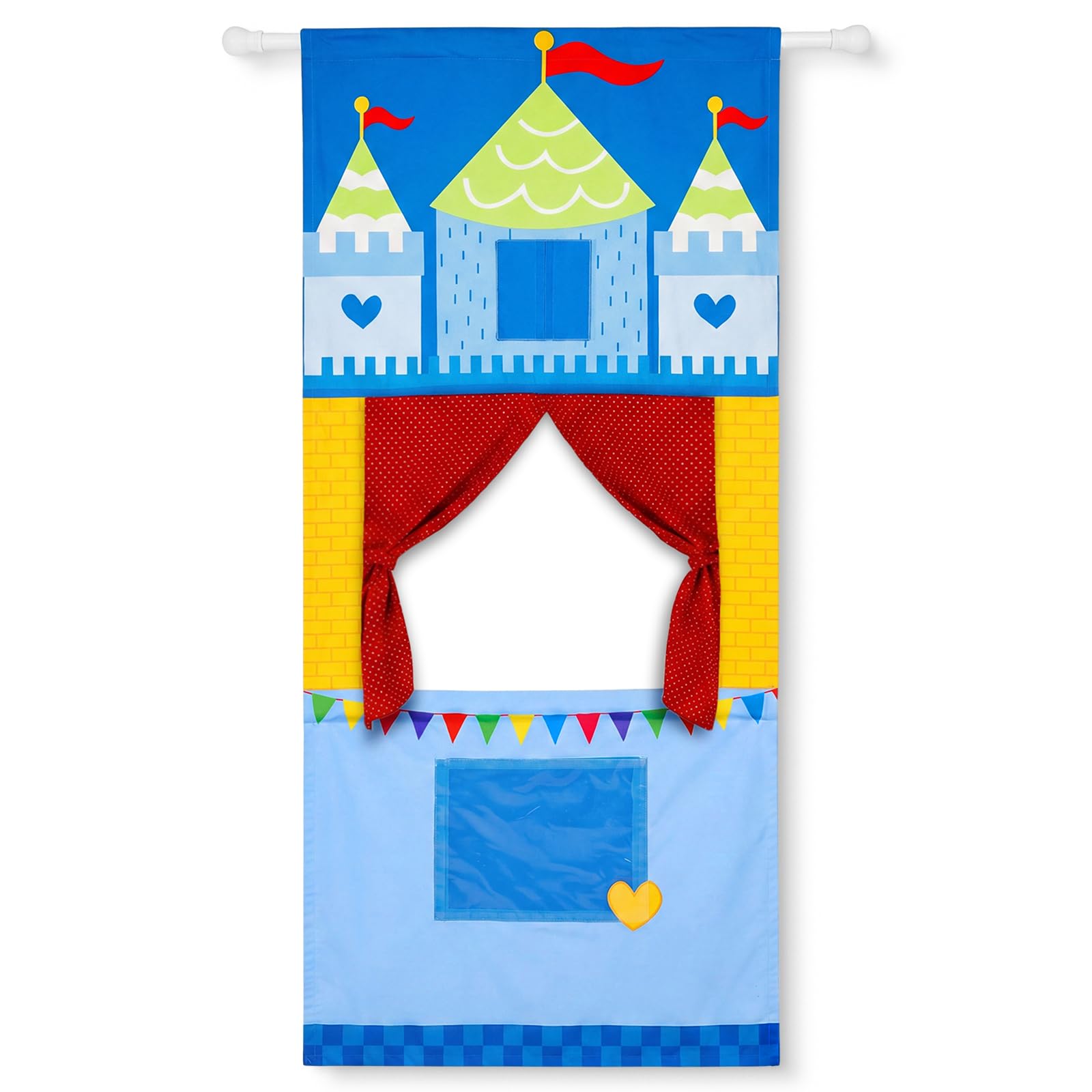
A doorway theater is a curtain, two rods, and a pattern, so the pattern does a lot of the work. VitalCozy's is a castle — towers either side of the show window, plus a second window off to one side that gives another performer somewhere to appear. On a plain white door frame it is instantly a set, which is more than you can say for a curtain.

It measures 67 x 31 inches, the same span as the HABA, and hangs from two height-adjustable rods made to fit standard doorways. At 0.75 kg the whole thing rolls into a drawer or the back of a closet, and setup is the extend-and-hang kind rather than a project. Customers describe it as easy to put up and easy to store, and the space-saving part is the reason to buy it.

What it doesn't give you is structure. There is no frame, no shelf, and nothing weighting the bottom, so a tug on the curtain moves the whole stage, and the fabric — flannelette and coarse linen — is softer and less crisp in the hand than a stiffer stage curtain. That is the nature of the format rather than a fault, and it is why we point to it when the HABA feels like too much money for a hanging cloth. For a hallway with a closed door, it does the job.

Bottom line: A good lower-cost doorway stage: the castle print is the most fun of the two hanging theaters here, and it rolls up small enough for a drawer.

#6

Rundad Wooden Puppet Theater

Rundad Wooden Puppet Theater

Theater and shop play

Doodle Score 9.0/10
Check Price

Worth Noting

  • Toddler scale, listed for 36 months to 5 years
Weight
14.7 lb
Included
2 plush hand puppets
Dimensions
24 x 10 x 46 inches
Reversible
Puppet theater and lemonade stand
Read the full review

Turn it one way and it is a puppet theater with a chalkboard for the show time. Turn it around and it is a lemonade stand with a shop counter. Reversible stages are common now, but this is the one where both sides feel finished rather than one of them being an afterthought you turn to the wall.

At 24 x 10 x 46 inches and 6.69 kg it is toddler scale: a three- to five-year-old sits behind it comfortably, a seven-year-old is folding up. The frame is wood, the curtains are plush, and the two plush hand puppets in the box mean it is playable the day it is built rather than after another order arrives. We also rate the small anti-tilt frame at the feet. It is the sort of detail you only notice when a child leans over the top and the whole stage doesn't move.

As value, we think it is the strongest of the wooden two-in-one stages: wood, curtains, a chalkboard, and puppets for less than the big floor models. The limitation is size, and it isn't a small one. This is a stage for the preschool years, listed from 36 months to five years, not one that grows with a seven-year-old. Buy it for the child who is three now and will get four solid years out of it.

Bottom line: The wooden two-in-one we recommend: puppet theater on one side, lemonade stand on the other, with two puppets in the box and a frame that resists tipping.

#7

Hey! Play! Tabletop Puppet Theater

Hey! Play! Tabletop Puppet Theater

Two-performer shows

Doodle Score 9.0/10
Check Price

Worth Noting

  • Folding hinges flex when leaned on
Storage
Folds flat
Material
Pine wood and MDF
Dimensions
30 x 26 inches
Recommended Age
3 to 5 years
Read the full review

Thirty inches wide and 26 tall — that is the widest tabletop stage in this group, and it is the whole reason to pick it. Two children can stand at it shoulder to shoulder, and there is room to set a puppet down between scenes without it sliding off the edge. Narrower tabletop theaters turn every show into a negotiation about whose turn it is.

The build is pine and MDF, with a blackboard and an interchangeable sign across the top, curtains that pull aside, and a three-sided box that folds flat for storage. The sign is the detail kids latch onto: the show gets a title before it gets a plot, and we have watched that turn into a whole ticket-selling operation.

Where it asks for care is the fold. Three panels that fold flat also fold the other way when a child leans hard on the proscenium, and the hinges are the part that takes the strain. This is a stage that wants a table and a calm audience rather than a rug and a two-year-old hanging off the front of it.

So it earns its place as the wide option rather than the tough one. Choose it over the Melissa & Doug tabletop if two performers matter more than a working curtain mechanism, and choose the Melissa & Doug if the stage has to survive being climbed on. Thirty inches of wooden stage is genuinely more theater than the narrower tabletops give you, and at this size that is the argument.

Bottom line: Worth it if width is your priority: the widest tabletop stage here, so two children can perform side by side, provided the audience stays calm.

#8

Le Toy Van Floor Puppet Theater

Le Toy Van Floor Puppet Theater

Heirloom gifts

Doodle Score 8.8/10
Check Price

Worth Noting

  • Puppets are sold separately
Weight
13.8 lb
Material
FSC-certified wood, water-based paint
Stage Details
Winding curtain, ticket and snack booths
Listed Dimensions
27.5 x 16.1 x 48 inches
Read the full review

Red paint, gold trim, and a curtain that winds up on a little brass-toned mechanism: the Le Toy Van is the only stage here that looks like something you leave out on purpose. It is also the tallest of the group, listed at 48 inches, and that extra height changes a show — children perform behind a proper proscenium rather than a hole near the floor, and the audience looks up at them.

The winding curtain is our favorite single piece of design in this entire group. Kids raise and lower it themselves, which turns the start of the show into a ritual instead of a scramble. The ticket booth and the snack-and-menu booth on the sides do the same for the queue outside, so one child sells tickets while another gets ready behind the curtain. It is FSC-certified wood with water-based paint and no plastic anywhere, and it feels like the piece you hand down.

The trade-offs are plain. Puppets are sold separately, so budget for a pair alongside it, and at 13.8 pounds this goes where you build it — it is not a stage a child drags between rooms. It is also the most expensive stage on this page by a wide margin. That makes it a grandparent gift, or the centerpiece of a nursery already decorated around it. For a playroom that takes a beating, the Melissa & Doug Deluxe is the more sensible spend; for something kept for the next child, this is the one.

Bottom line: Buy this if a puppet theater is going to be a piece of the room: the most beautiful and best-detailed stage here, priced like furniture and worth it for a keepsake gift.

#9

Alvantor Pop-Up Puppet Theater

Alvantor Pop-Up Puppet Theater

Parties and playdates

Doodle Score 8.8/10
Check Price

Worth Noting

  • Plastic poles bend under rough play
Size
28 x 20 x 41 inches
Setup
No tools required
Weight
2.1 lb
Capacity
Fits 2 to 3 kids
Read the full review

Twenty-eight inches wide, 20 deep, 41 tall, 2.1 pounds, no tools: this is the least expensive way into a full-size stage here, and the only one that is standing within a couple of minutes of opening the box. It is a fabric playhouse with a padded front stage where kids line toys up in the audience, and it fits two or three children inside at once — something none of the wooden stages here can do.

We treat it as the party and backyard stage. It is sold for indoor and outdoor play, it folds into its own bag, and it moves from the living room to a birthday party without a second thought. What it won't do is survive being sat on: the frame is plastic poles, and a bent pole is the end of that section. For a three- and five-year-old who mostly perform sitting down, that trade is worth making; for a rough playroom, the wooden stages above hold up better.

The reversal is a flap and a sign. Turn it around and the same tent becomes a lemonade stand, which in summer doubles the number of afternoons it comes out of the bag. That is the sort of feature that reads as a gimmick in a listing and turns out to be the reason a toy gets used in July.

Bottom line: Our budget pick: a full-size pop-up stage for playdates and parties that goes up in minutes, as long as everyone performs sitting down.

How We Tested Puppet Theaters

We began by gathering more than two dozen puppet theaters sold in the U.S., then narrowed the list by reading specs and customer reviews for recurring complaints: missing hardware, cramped stages, wobbly frames, and footprints that swallow a playroom. From that pool we ordered nine — a mix of tabletop and floor-standing styles — and tested them for seven months.

Each theater arrived in a box; before building, I laid every screw, dowel, and curtain rod on a towel and checked the count against the manual. I timed assembly solo and noted where instructions stalled or a second pair of hands was needed. Then I measured the assembled footprint, stage opening, and height against a standard doorway and playroom corner, because a theater that doesn't fit is a theater that gets returned.

The real test happened during after-school shows, a rainy Saturday marathon, and a birthday party with four kids rotating puppets. I watched whether children could reach the stage, work the curtains, and step behind it without knocking the frame. After each session, I checked hinges, curtain rods, and fabric seams; I also nudged the frame on carpet and hardwood to see how much it slid or swayed. Theaters that survived being packed away and rebuilt got extra credit, and I left each one in the living room for a week to judge appearance and compare the materials with what the theater cost.

How to Choose

Start with the room, not the paint

Four formats cover almost everything: a floor-standing wooden stage, a tabletop stage, a curtain that hangs in a doorway, and a pop-up tent. Each solves a different space problem. A floor stage like the Melissa & Doug Deluxe is 52 inches across and wants a wall; a tabletop theater needs a table nobody eats at; a doorway curtain needs a frame wide enough and a household willing to walk around it.

The trap in the listings is the word compact. It usually describes the box, not the footprint — a stage that ships flat can still stand four feet tall once built. Check assembled dimensions rather than package dimensions before you clear a corner for it.

Check where the show window lands

A stage only works if a child can reach the opening without stretching, and window height decides that more than overall size does. A low floor stage lets a preschooler sit on the floor and perform at eye level. A 67-inch doorway curtain hangs its window at adult height, which suits a six-year-old standing up and frustrates a toddler.

Width decides how many performers. Under about 25 inches is a one-child stage; 30 inches and up lets two work side by side. The pop-up tents solve it differently — two or three children climb inside rather than standing behind a curtain.

Assembly, and where it lives at nine at night

Wooden stages are an evening with a screwdriver, and on some kits the holes do not line up first time. Fabric formats go up in minutes: a doorway curtain is two rods, and a pop-up is standing before the kids have their puppets out of the box.

Be honest about whether the stage will stay up. A floor model becomes furniture and needs a permanent corner, a tabletop stage stores flat, and a doorway curtain rolls into a drawer. If you don't have the corner, don't buy the corner stage — the HABA or the Melissa & Doug tabletop will get used more.

Sturdiness is about the base, not the panels

What tips a puppet theater is a child leaning over the top to work a puppet, not the thickness of the wood. Look for a wide footprint, a low center of gravity, and bracing at the feet — the non-tip base on the Melissa & Doug Deluxe and the auxiliary foot frame on the Rundad are both doing that job.

Pop-up tents bend at the poles because the poles are the structure. That is the trade for something that weighs about two pounds and packs into a bag, and it is worth making consciously rather than discovering it.

One stage, two games

A reversible design — theater on one side, shop or lemonade stand on the other — roughly doubles the number of days a stage gets used, and both the Rundad and the Alvantor build it in. We think it is worth paying a little more for when a child is deep in pretend-shop play as well as puppets.

If the puppets are the whole point, skip the reversal and put the money into the frame instead. A plainer, heavier stage that stays upright will outlast a clever one that wobbles.

Frequently Asked Questions

Final Verdict

The Melissa & Doug Deluxe is the one we recommend first: 52 inches of stable wooden stage that two children can share and that does not tip when they lean on it. It is the safest bet for a family with a spare wall.

If floor space is the problem, take the HABA doorway curtain instead — it hangs, performs, and disappears into a closet. If the budget is tight or the stage needs to travel to a birthday party, the Alvantor pop-up is the honest choice, as long as everyone performs sitting down.