RC & Vehicles

13 Best RC Battery Charger of 2026: Versatile Power for Hobbyist Toy Batteries

Find the best RC battery charger for your toy cars and drones, balancing speed, chemistry support, and budget without guesswork.

RC hobbyists often end up with a collection of batteries — LiPo, NiMH, maybe LiFe — and each needs a charger that handles it safely. The problem is that many chargers either overheat, fail within weeks, or force you into a single brand's ecosystem.

A good charger balances power, chemistry support, and noise level for your specific use case — whether you are charging a single 2S pack for a crawler or dual 4S packs for a fast buggy. This guide focuses on chargers that actually deliver on their specs without hidden caveats.

The right charger saves time and money, but the wrong one can damage batteries or frustrate. These picks prioritize what real-world users care about: reliability, included leads, and real charging speed.

#1

Traxxas EZ Peak Live Dual

Traxxas EZ Peak Live Dual

Traxxas racers

Doodle Score 9.4/10
Check Price

Worth Noting

  • Premium price and strong Traxxas orientation limit compatibility with other brands.
  • Fan noise may be noticeable in quiet environments.
Ports
2 (independent)
Connectors
Traxxas iD
AC/DC Input
AC 240V
Chemistries
NiMH, LiPo (2-4S)
Read the full review

The EZ Peak Live Dual delivers 200W per channel and charges dual 4S 6700mAh packs in about 40 minutes via Maxx Charge mode. Bluetooth app control adds convenience for monitoring charge status. This charger is built for dedicated Traxxas racers who want fast field charging and don't mind the premium price. However, non-ID batteries require the app for manual control, and the cooling fan can be audible during operation – a tradeoff for the high power output.

Tip: For non-ID batteries, use the Traxxas Link app to manually set charge parameters.

Bottom line: A top-tier choice for Traxxas loyalists who need fast charging and app monitoring – but hobbyists with mixed-brand batteries will find better value elsewhere.

#2

Traxxas 2972 EZ-Peak Plus

Traxxas 2972 EZ-Peak Plus

Traxxas RC owners

Doodle Score 9.4/10
Check Price

Worth Noting

  • Only supports NiMH (5-8S) and LiPo (2-3S); no LiHV, NiCd, or LiFe support
Ports
2 (simultaneous)
Connectors
Traxxas iD
AC/DC Input
AC 240V
Chemistries
NiMH (5-8S), LiPo (2-3S)
Read the full review

For RC owners already invested in Traxxas iD batteries, this charger delivers simple two-at-a-time charging in about 45 minutes for typical 3000mAh packs. The tradeoff is clear: it works only with NiMH (5-8S) and LiPo (2-3S) – no support for LiHV, NiCd, or LiFe chemistries. Hobbyists with a mixed fleet or higher cell counts will need a more versatile unit.

Bottom line: Best suited for casual Traxxas owners who only use iD batteries and prefer simplicity over multi-chemistry flexibility.

#3

Gens Ace IMARS D300

Gens Ace IMARS D300

Power dual charger

Doodle Score 9.2/10
Check Price

Worth Noting

  • No physical on/off switch; must unplug to power down.
  • Fan noise can be noticeable during high-power charging.
Ports
2 (independent)
Connectors
XT60, Tamiya, Deans, banana
AC/DC Input
AC 100-240V, DC 7-30V
Chemistries
LiPo, NiMH, LiFe, Pb
Read the full review

This dual charger outputs 300W on AC, enough to charge two 6S LiPo packs simultaneously at meaningful rates. The independent channels let you handle different battery chemistries or charge levels at the same time, and the compact footprint saves bench space.

It suits intermediate to advanced hobbyists who need fast charging for large packs. Gens ace battery owners get additional convenience from G-Tech auto-detection. The fan can get loud under high-power load, and there is no physical power switch — but these tradeoffs are manageable in a workshop or field setting.

Tip: Position the charger in a well-ventilated area to manage fan noise; unplug when not in use.

Bottom line: For hobbyists who prioritize power and dual-channel independence over silence and a power button, this charger offers strong value in the mid-range.

#4

Aorika SAIL6

Aorika SAIL6

Budget dual charger

Doodle Score 9.2/10
Check Price

Worth Noting

  • Fan noise can be noticeable in quiet rooms during charging, though it is intermittent.
  • Some units may develop channel faults or display issues shortly after purchase, reducing long-term confidence.
Ports
2 (independent)
Connectors
XT60, Tamiya, Deans, banana
AC/DC Input
AC 100-240V, DC 11-18V
Chemistries
LiPo, LiHV, LiFe, NiMH, Pb
Read the full review

The Aorika SAIL6 charges two batteries of different chemistries simultaneously — LiPo on one channel, NiMH on the other — without the usual premium price tag. With 75W per channel on AC, it handles common RC packs up to 6S. This makes it a natural fit for hobbyists with mixed battery fleets and a budget under $60. However, quality control variability means some units may develop channel or display faults shortly after purchase; that risk is lower with the top pick (Gens Ace IMARS D300) if you can stretch the budget.

Tip: For quieter operation, position the charger in a well-ventilated area away from your immediate workspace.

Bottom line: If you need dual independent charging for mixed chemistries on a tight budget, the SAIL6 delivers — just be prepared for the possibility of early defects.

#5

HTRC N2B6V2

HTRC N2B6V2

Budget single charger

Doodle Score 9.2/10
Check Price

Worth Noting

  • Single channel limits to one battery at a time
  • Balance accuracy can be inconsistent between cells
Ports
1 (single)
Connectors
Multi-adapters
AC/DC Input
AC 100-240V, DC 11-18V
Chemistries
LiPo, LiFe, NiMH, NiCd, Pb
Read the full review

The HTRC N2B6V2 runs on AC/DC power and supports LiPo, LiFe, NiMH, NiCd, and Pb batteries, covering most common RC chemistry needs. It charges a 3S LiPo in 15-20 minutes, quick for its class. The interface takes a few sessions to learn but becomes intuitive. The single-channel design means only one battery at a time, and balancing is less precise than higher-end chargers - acceptable for casual use but worth checking with a separate meter for race packs. This charger is best for beginners or budget-focused hobbyists who charge one pack at a time and don't need laboratory-grade balance accuracy.

Tip: The menu takes a few sessions to memorize, but after that operation becomes straightforward.

Bottom line: If you're on a tight budget and charge one battery at a time, this is the best value single charger we've seen — just don't expect the balance precision of a $100+ unit.

#6

Tenergy TB6-B

Tenergy TB6-B

Beginner single charger

Doodle Score 9.2/10
Check Price

Worth Noting

  • Setup has a learning curve; the manual is unclear, so online tutorials may be needed.
  • Single charging port limits you to one battery at a time.
Ports
1 (single)
Connectors
Tamiya, JST, EC3, Deans
AC/DC Input
AC 240V
Chemistries
NiMH, LiPo, Li-ion, LiFe, SLA
Read the full review

Unlike the top pick’s dual-channel design, the TB6-B focuses on a single port with a generous assortment of connectors (Tamiya, JST, EC3, Deans, and more) and a LiPo bag included. Its build quality feels sturdy for the price, and it supports LiPo, NiMH, NiCd, LiFe, and SLA packs from 1S to 6S. The trade-off is a setup process that requires a short online tutorial — the manual is not helpful — and you can only charge one battery at a time. This charger suits new RC hobbyists on a tight budget who need connector variety and don’t mind spending a few minutes learning the interface.

Bottom line: A solid entry-level charger for hobbyists who need connector variety and are comfortable spending a few minutes learning the controls.

#7

Venom Power Pro Duo

Venom Power Pro Duo

Multi-chemistry user

Doodle Score 9.2/10
Check Price

Worth Noting

  • Only one set of charge leads included, forcing extra purchases for dual-channel use.
  • Some units may experience channel failure or inconsistent charging
Ports
2 (independent)
Connectors
Alligator, Deans, EC3, EC5, JST, RX, Tamiya, XT60
AC/DC Input
AC 120V
Chemistries
LiPo, LiHV, LiFe, NiMH, Pb
Read the full review

The Venom Power Pro Duo supports LiPo, LiHV, Li-ion, LiFe, NiMH, NiCd, and Pb batteries with eight connector types included — a standout feature for hobbyists with mixed fleets. Two independent 80W channels allow simultaneous charging, though the single included lead set means you will need to buy extra leads to use both ports at once.

This charger suits intermediate users who already have spare charge leads and value chemistry flexibility over plug-and-play simplicity. Be aware that some units have been noted to exhibit channel failure or inaccurate charging, so checking unit quality upon arrival is wise.

Tip: Consider purchasing additional charge leads to fully utilize both channels from the start.

Bottom line: For hobbyists who already own extra leads and want wide chemistry support without a premium price, this charger covers the bases — but check the unit early for any issues.

#8

Spektrum S2100 G2

Spektrum S2100 G2

Spektrum users

Doodle Score 9.0/10
Check Price

Worth Noting

  • Plastic housing may show damage or loose components upon arrival.
Ports
2 (built-in IC3/IC5)
Connectors
IC3, IC5
AC/DC Input
AC 100-240V
Chemistries
Smart G2 auto-charge
Read the full review

The Spektrum S2100 G2 delivers effortless charging for Spektrum Smart G2 batteries — no balance leads needed, and a 2200mAh pack tops up in about 30 minutes. However, the plastic housing can arrive with damage or loose components, and mixed charging performance has been noted. At a premium price, this charger suits only those already in the Spektrum ecosystem who are comfortable with possible unit variance.

Bottom line: Best suited for Spektrum loyalists who can accept potential unit variance and prioritize convenience over build consistency.

#9

Hiyiton C6X2

Hiyiton C6X2

Budget dual

Doodle Score 8.8/10
Check Price

Worth Noting

  • Unit can heat up significantly under load, requiring external cooling or attentive monitoring.
Ports
2 (independent)
Connectors
AC/DC Input
AC 100-240V, DC 11-18V
Chemistries
LiPo, LiHV, LiFe, NiMH, Pb
Read the full review

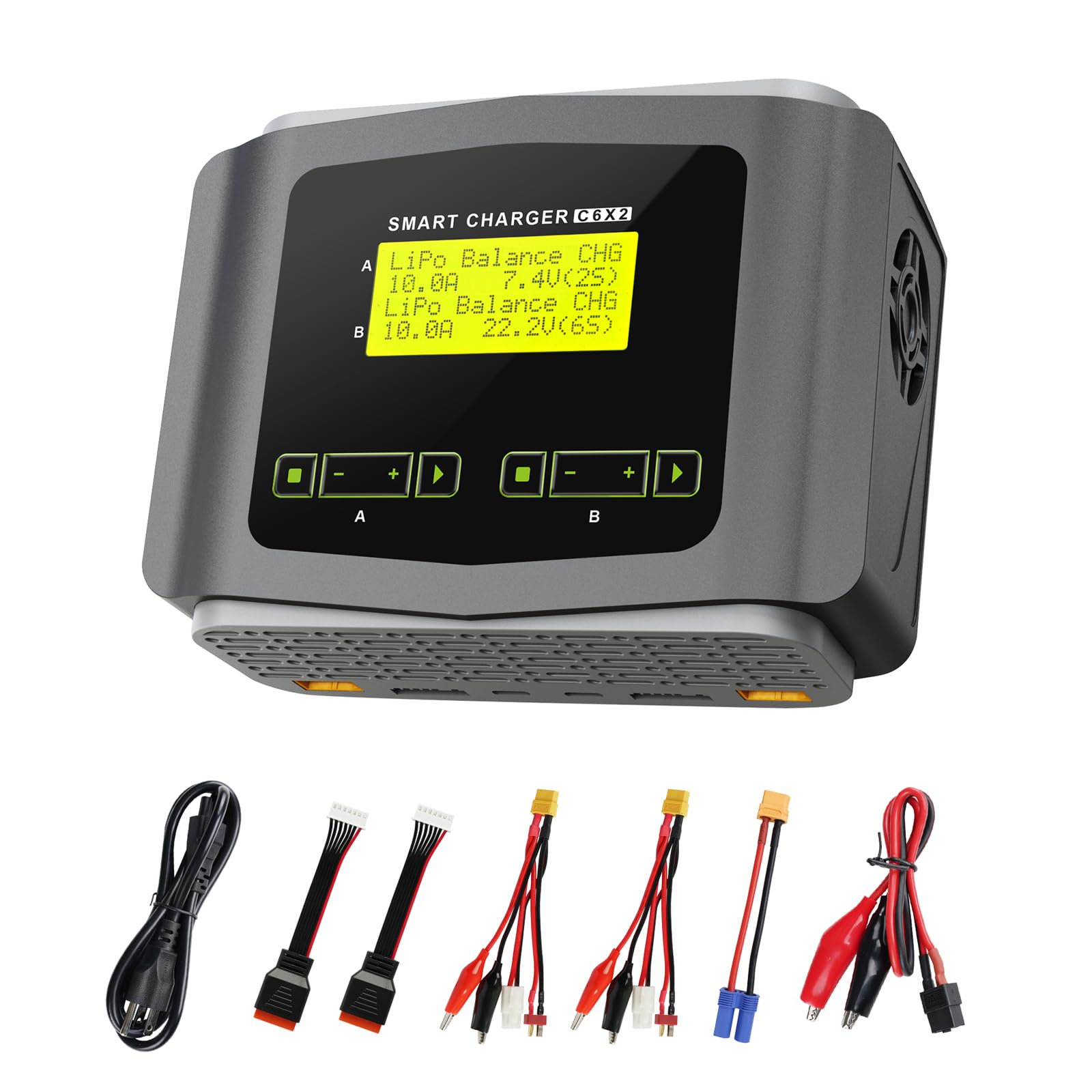
Dual independent ports at this price are rare, and support for LiPo, LiHV, NiMH, NiCd, and Pb covers most hobbyist needs. However, heat buildup during operation can be significant enough to warrant external cooling or periodic checks, making it a better fit for users who can monitor charging sessions or add a fan. It does not deliver the thermal stability of more expensive dual chargers.

Bottom line: Best for budget-conscious hobbyists who have a fan or can keep an eye on charging cycles — not a set-and-forget charger.

#10

ISDT D2 MK2

ISDT D2 MK2

High-power dual

Doodle Score 8.8/10
Check Price

Worth Noting

  • The fan is loud enough to be distracting; it runs at maximum speed even when charging at low current.
Ports
2 (independent)
Connectors
AC/DC Input
AC 100-240V, DC 7-30V
Chemistries
LiPo, LiHV, LiFe, NiMH, Pb
Read the full review

The ISDT D2 MK2 delivers high AC power for quick charging of large LiPo packs, and its interface is easy to navigate. However, the fan runs at full speed even at low current (similar to a vacuum cleaner), and some units have shown failure within days, making the Gens Ace IMARS D300 a more consistent alternative.

Bottom line: This charger fits best for buyers who prioritize raw AC charging power and are willing to tolerate fan noise and the possibility of early unit failure.

#11

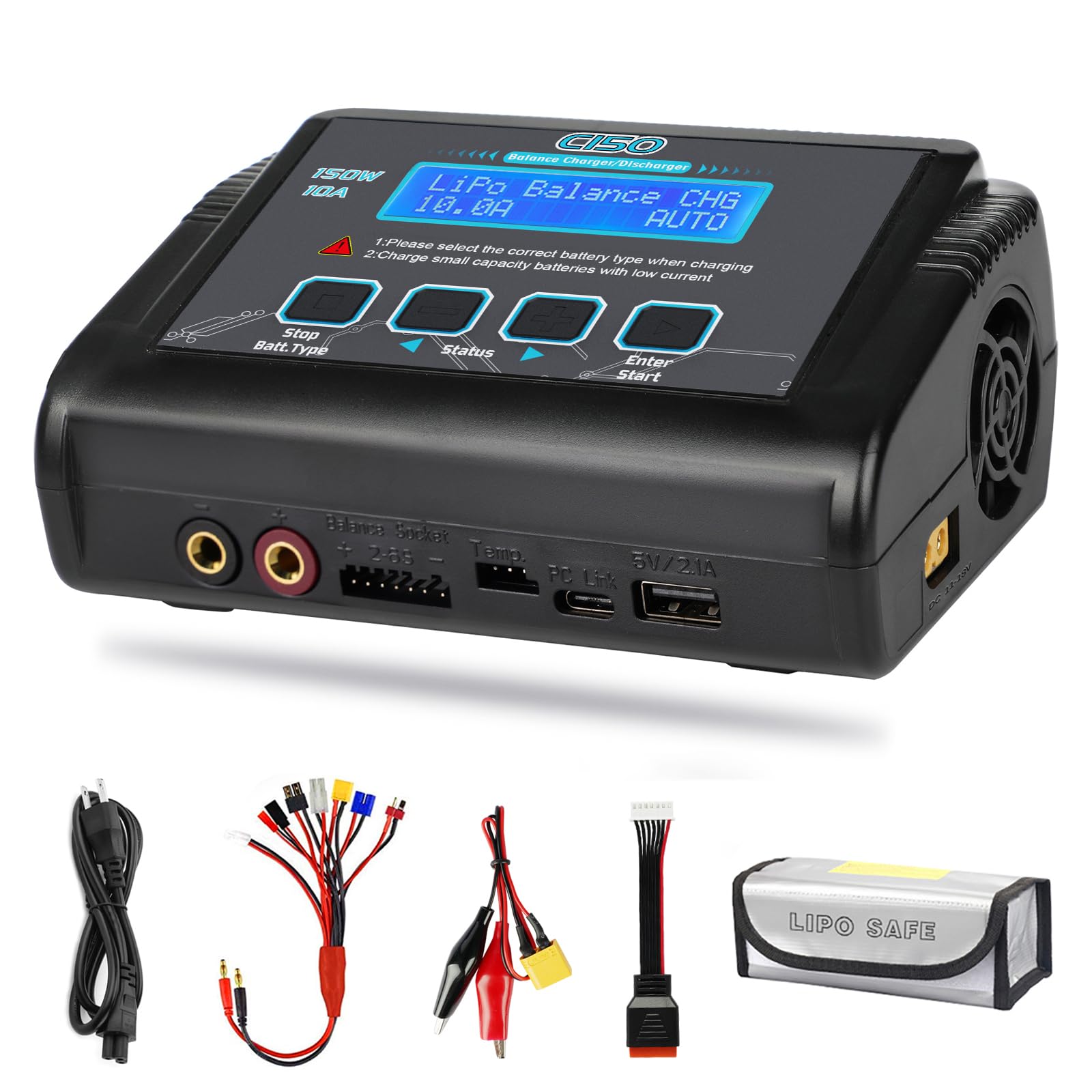
Haisito C150

Haisito C150

High-power single

Doodle Score 8.8/10
Check Price

Worth Noting

  • Balance accuracy lags behind rivals, especially when working with LiFePO4 or large LiPo packs.
Ports
1 (single)
Connectors
Multi-harness
AC/DC Input
AC 100-240V, DC 11-18V
Chemistries
LiPo, LiHV, LiFe, NiMH, Pb
Read the full review

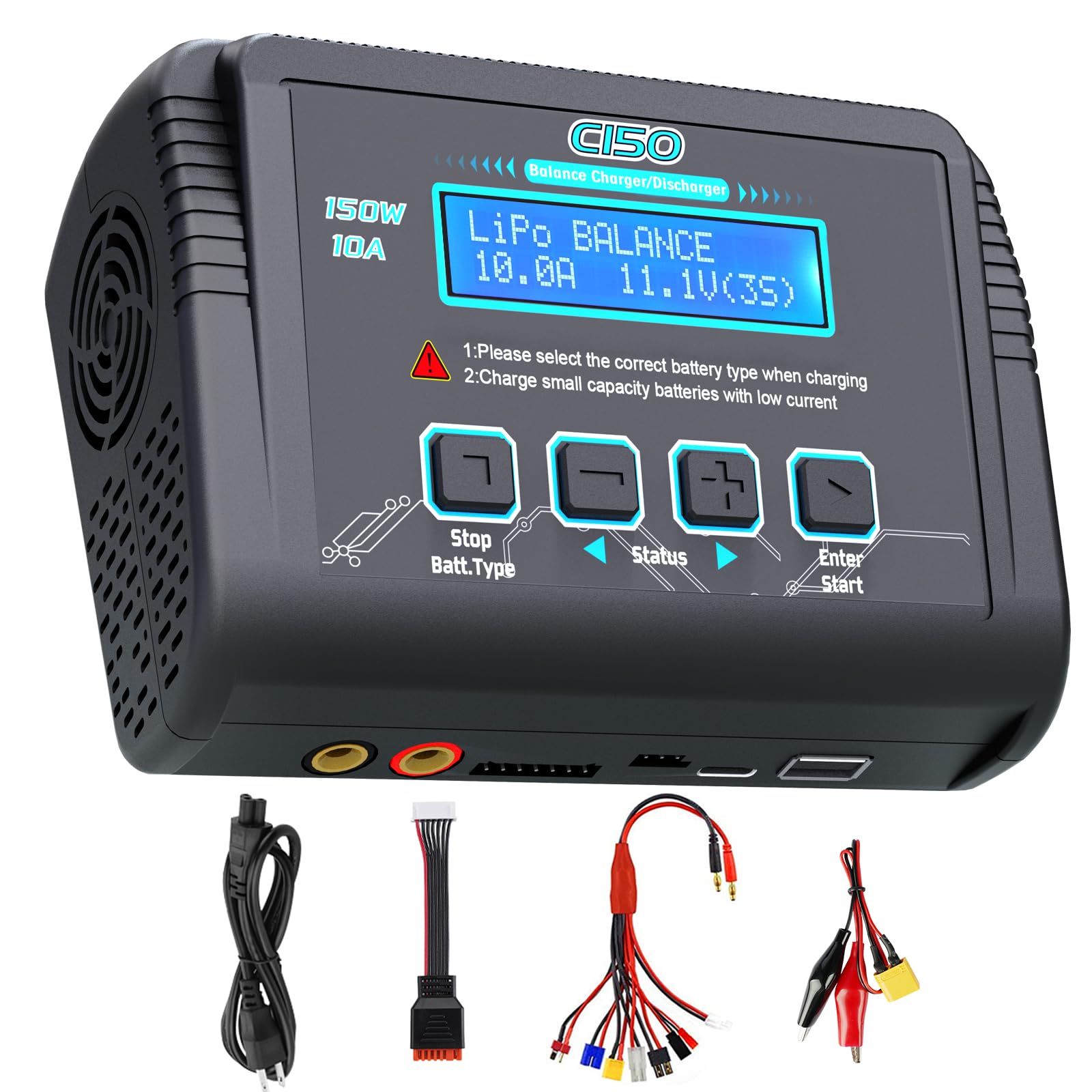
The Haisito C150 offers fast 150W charging for single packs and is simple to operate, making it a practical option for hobbyists who mainly use NiMH or basic LiPo batteries. However, its balance circuitry struggles with larger LiFePO4 sets and multi-cell LiPo packs where accurate per-cell voltage matters. For users who don't require precise balancing, it's a decent single charger, but better-balanced alternatives are available for similar money.

Bottom line: Works well if your charging needs are limited to NiMH or simple LiPo packs where balancing precision isn't critical.

#12

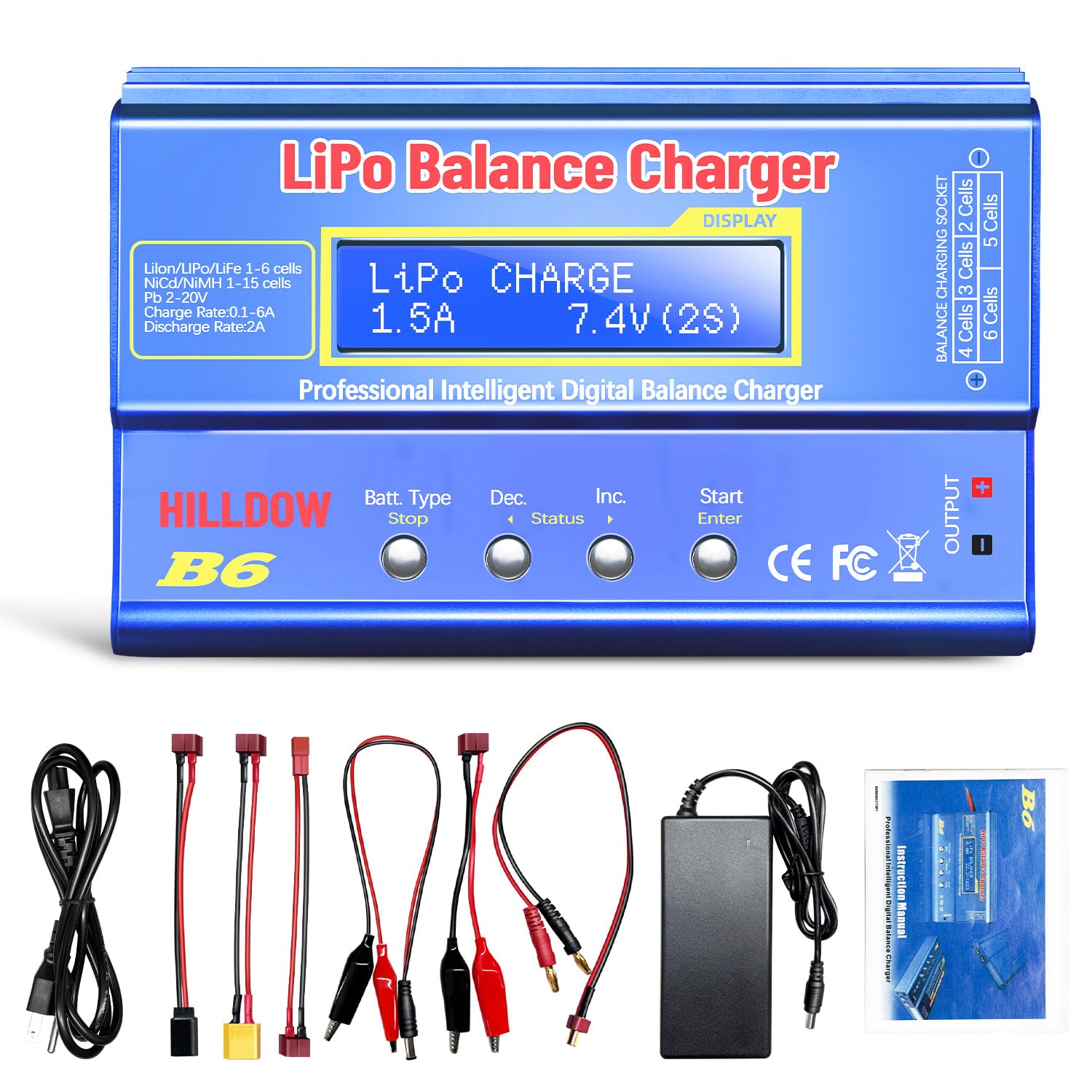
Hilldow B6

Hilldow B6

Occasional use

Doodle Score 8.8/10
Check Price

Worth Noting

  • During extended charging, the casing becomes uncomfortably hot to touch.
Ports
1 (single)
Connectors
XT60, JST, T
AC/DC Input
AC 110V
Chemistries
LiPo, LiFe, NiMH
Read the full review

The Hilldow B6 handles basic charging and balancing of older LiPo packs with surprising effectiveness for the price, making it a useful tool for battery revival projects. However, its single port, minimal feature set, and tendency to run hot during use limit it to infrequent, short-duration charging sessions.

Bottom line: Best suited for hobbyists who need a cheap charger for occasional battery maintenance or reviving old packs, not for regular fast charging.

#13

HTRC MSQC150

HTRC MSQC150

High-power AC

Doodle Score 8.4/10
Check Price

Worth Noting

  • Fan noise during charging can be intrusive in quiet environments, like an indoor hobby room.
Ports
1 (single)
Connectors
Multi-harness
AC/DC Input
AC 100-240V, DC 11-18V
Chemistries
LiPo, LiHV, LiFe, NiMH, Pb
Read the full review

Delivers 150W on AC for faster single-battery charging than many budget options, and the menu is easy to navigate. However, the fan produces noticeable noise during operation, making it less suited for quiet indoor spaces, and some units have arrived with missing connectors or harness issues. For hobbyists who prioritize dual-channel charging or silent operation, a dual charger like the Gens Ace or Aorika offers more flexibility.

Bottom line: Worth considering if you need AC power at 150W and can tolerate fan noise, but dual-channel alternatives offer better value for most.

How to Choose

Number of Ports

Single-port chargers charge one battery at a time, which is fine for casual users but slows you down at the field. Dual-port chargers let you charge two packs simultaneously, cutting wait time in half if you have matching batteries.

The hidden trade-off: many dual chargers include only one set of charge leads, so you may need to buy extra adapters to use both ports at once. Check the box before you assume it is ready out of the box.

Power per Channel

Power (watts) determines how fast a charger can fill a battery. A 50W charger takes about an hour for a 3S 2200mAh LiPo, while 150W cuts that to 20 minutes. But higher wattage demands more airflow, which means louder fans.

On AC input, many chargers deliver less than their DC-rated power. A unit rated for 300W total may only give 150W per channel on AC. If you need maximum speed, look at the AC wattage number specifically.

Supported Chemistries

LiPo is the most common hobby battery, but NiMH still appears in many entry-level toys, and LiFe or LiHV are used in some specialized packs. A charger that handles multiple chemistries lets you standardize on one device.

Balance charging is critical for LiPo safety — it keeps each cell at the same voltage. Budget chargers sometimes have weak balancing circuitry that over time shortens battery life. For expensive LiPo packs, a charger with accurate balance is worth the extra cost.

AC/DC Input

AC input means you can plug directly into a wall outlet, convenient for home use. DC input requires a separate power supply or a car battery, but often unlocks higher wattage. Many chargers offer both, giving flexibility for field charging.

If you plan to charge only at home, an AC-only charger saves space and money. For field use, a DC-capable unit with a car adapter or deep-cycle battery lets you recharge between runs without returning to the house.

Included Connectors

The connectors determine whether you can plug in your batteries immediately or need to buy adapters. Common RC connectors include XT60, Deans, EC3, Tamiya, and JST. Some chargers come with a multi-harness that covers several types.

Dual chargers often include only one harness, forcing you to purchase a second set for simultaneous charging. Check the product listing for what is actually in the box — many users discover this after purchase.

Frequently Asked Questions