Baby & Toddler

11 Best Toddler Activity Center 2026: Stable Convertibles for Longer Use

Which convertible activity centers remain safe and sturdy for toddlers beyond 18 months? A guide to picking stable, long-lasting play tables without tipping woes.

Activity centers promise years of use, but many lightweight designs wobble once your baby starts pulling up. The real challenge is finding a center that stays planted on hardwood floors and doesn't lose its legs after a few months.

Many convertible tables claim to grow with your child, yet they often become too short for toddlers or tip over when used as a standing support. Manual models without batteries tend to avoid the glitchy electronics and sliding problems that plague their battery-powered counterparts.

This guide focuses on centers that maintain stability through all stages — from infant seat to toddler table — so you don't have to supervise every lean or worry about parts falling off.

#1

Fisher-Price 3-in-1 Spin

Fisher-Price 3-in-1 Spin

Manual simplicity

Doodle Score 9.6/10
Check Price

Worth Noting

  • Removable toy attachments may loosen during vigorous play.
Modes
Infant, floor, toddler table
Age Range
4 months–toddler (25 lbs seat)
Activities
10+ on 4 pods
Read the full review

The Spin & Sort's wide footprint keeps it planted during seated play, while the spinning pods, shape-sorter, and chime drum provide varied tactile activities without any batteries or electronics. Assembly takes minutes and disassembly for storage is equally quick — no tools required. The seat pad is machine-washable, and the entire unit is built from durable plastic that withstands daily use.

Best suited for babies 4–12 months who need a stationary seat (not a bouncer or walker) and for toddlers up to 25 pounds transitioning to the table mode. The removable toy attachments can come loose during active play; occasional reattachment is needed, but the parts are not small enough to pose a choking hazard. For older toddlers using the table, the low height and wide base provide a stable surface for standing play.

Tip: Ensure all toy pods are fully snapped in before play; attachments can work loose during spinning.

Bottom line: For a no-fuss, battery-free activity center that converts from seat to table, this Fisher-Price model delivers a stable base and enough variety to engage infants and toddlers alike.

#2

LeapFrog Learn & Groove

LeapFrog Learn & Groove

Budget families

Doodle Score 9.6/10
Check Price

Worth Noting

  • On hard floors, the table slides during play and may tip when used as a standing support.
Modes
Floor table
Age Range
6–36 months
Activities
70+ songs, bilingual
Read the full review

A budget-friendly musical floor table with 70+ songs and bilingual (English/Spanish) learning – more content per dollar than electronic desk alternatives. Best for families focused on floor play with babies who are not yet pulling up to stand; the lightweight design shifts on hard surfaces, so supervision is recommended on rugs or with non-slip mats.

Tip: Place on a rug or use anti-slip pads to keep the table steady during active play.

Bottom line: Ideal for budget-conscious parents seeking a rich bilingual music table for seated floor play.

#3

Skip Hop Discoverosity

Skip Hop Discoverosity

Sensory play

Doodle Score 9.6/10
Check Price

Worth Noting

  • User reviews may be from a different product, so feedback on assembly and durability is unverified.
  • No electronic features
Modes
Floor play, table play, play table
Age Range
18 months–6 years
Activities
30+ sensory with 13 tools
Read the full review

The Skip Hop Discoverosity gives toddlers a low-tech, hands-on sensory experience with two bins and 13 nature-inspired tools, converting between floor and table modes. Its polypropylene construction and FSC-certified wood top are built for ages 18 months to 6 years. However, user reviews may come from a different product, so assembly and long-term durability are unverified. This table is best for parents who want an inexpensive, electronics-free tactile play station and are comfortable with some uncertainty around user feedback.

Bottom line: For parents seeking a straightforward sensory table at a budget price, the Skip Hop Discoveriosity delivers — just be aware that its review history is unclear.

#4

Skip Hop Explore & More

Skip Hop Explore & More

Long-lasting

Doodle Score 9.6/10
Check Price

Worth Noting

Modes
3-stage (sit, cruise, table)
Age Range
4 months–25 lbs
Activities
25+ (light-up piano, peek-a-boo)
Read the full review

Three-stage design with rotating seat, light-up piano, and 25+ activities. Customer feedback is unavailable, so real-world durability and engagement remain unverified. A solid option for those prioritizing brand features over user reviews.

Bottom line: For parents who value Skip Hop's brand reliability and want a convertible center with multiple activity modes, this fits well.

#5

Baby Einstein Neptune Jumper

Baby Einstein Neptune Jumper

Bouncing babies

Doodle Score 9.4/10
Check Price

Worth Noting

  • In some cases, the seat rotation is stiff and requires noticeable effort from babies to spin.
Modes
Stationary jumper 360° seat
Age Range
6 months–25 lbs
Activities
Ocean toys, multilingual sea turtle
Read the full review

The Neptune Jumper delivers strong entertainment value with a variety of engaging ocean-themed toys, sturdy construction, and straightforward assembly. It focuses on bounce play rather than table or walker modes — ideal for families who want a dedicated stationary jumper. The 360° seat rotates, but some babies may find the rotation stiff and need extra effort to turn, which is worth considering if your child is less motivated to spin.

Tip: If your baby is less motivated to spin, encourage rotation by placing favorite toys around the seat.

Bottom line: Best for families who want a feature-packed stationary jumper that prioritizes bounce play and stability, with seat rotation that may be less smooth than some alternatives.

#6

VTech Magic Star Table

VTech Magic Star Table

Tight budget

Doodle Score 9.4/10
Check Price

Worth Noting

  • Lightweight construction can slide on hard floors during active play
  • Smaller table height may not accommodate toddlers who stand or need a taller surface
Modes
Floor play (legs removable)
Age Range
6–36 months
Activities
6 bilingual activities, steering wheel
Read the full review

The VTech Magic Star Learning Table offers six bilingual activities including a steering wheel and phone, all at a price well below other interactive tables. Its removable legs let younger babies play on the floor, and the bilingual English/Spanish content keeps them engaged. This table is lightweight and slides on hard floors, and its smaller height suits babies who sit and play rather than those learning to stand. For families on a tight budget with infants aged 6 to 12 months, the Magic Star delivers strong educational entertainment without the premium price tag.

Tip: Place on a rug or non-slip mat to reduce sliding on hard floors.

Bottom line: A cost-effective choice for families who want a bilingual activity table for seated play; less suitable if your baby is already pulling up or needs a stable standing support.

#7

Smart Steps Bounce N Play

Smart Steps Bounce N Play

Bouncing option

Doodle Score 9.4/10
Check Price

Worth Noting

  • Base may wobble, especially on carpet or uneven flooring
Modes
3-in-1 (activity, table, flat)
Age Range
6–15 months (activity), converts to table
Activities
Musical keyboard
Read the full review

This 3-in-1 activity center offers a 360° rotating seat and a 3-position bounce board that babies enjoy, plus a musical keyboard. However, the base can wobble on some floors, so check stability during setup. It’s a decent value for the features but not for those needing rock-solid stability.

Bottom line: A functional 3-in-1 for bouncing and play, but inspect the base stability before committing — best for families who prioritize features over rock-solid construction.

#8

Tiny Love 4-in-1

Tiny Love 4-in-1

Multifunctional

Doodle Score 9.2/10
Check Price

Worth Noting

  • Stiff wheels make walker mode difficult for babies to push around
Modes
Stationary, jumper, walker, push
Age Range
6 months–toddler (13 lbs walker)
Activities
28+ activities
Read the full review

This center offers abundant play options with a rotating seat and interactive toys that keep little ones engaged. The walker mode, however, uses stiff wheels that resist easy movement - better to keep it stationary where it truly shines.

Bottom line: Choose this if you want a jam-packed stationary jumper with lots of activities and don't need a functional walker.

#9

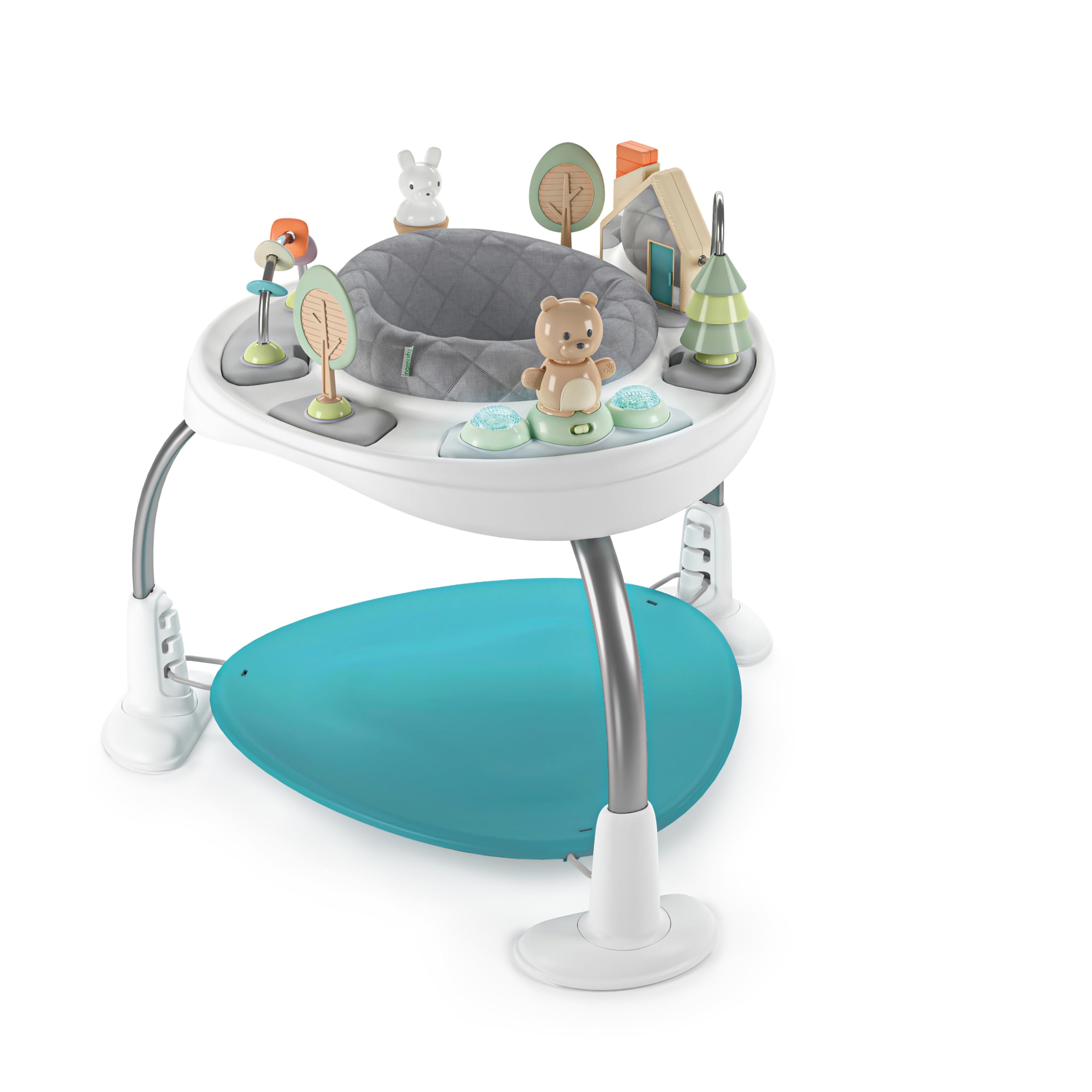
Ingenuity Spring & Sprout

Ingenuity Spring & Sprout

Neutral design

Doodle Score 9.2/10
Check Price

Worth Noting

  • Seat may be snug for larger babies, limiting comfort during jumper mode.
Modes
Jumper and activity table
Age Range
6–24 months (jumper 6-12, table 12-24)
Activities
11 nature-inspired with lights
Read the full review

The Ingenuity Spring & Sprout offers a cute, neutral design and easy assembly, transitioning from a jumper to an activity table for extended use. Sturdy construction supports development through interactive toys and lights. However, the seat may be tight for larger babies, making this best suited for smaller infants within the 6-12 month jumper range.

Bottom line: Ideal for parents who want a visually calm activity center that transitions to a table, provided their baby is on the smaller side.

#10

Baby Einstein Around We Grow

Baby Einstein Around We Grow

Many modes

Doodle Score 9.2/10
Check Price

Worth Noting

  • Toy attachments may come loose and the center can wobble during active use
Modes
4-in-1 (walker, table, art, floor)
Age Range
6–36 months
Activities
15+ including light-up piano
Read the full review

This center keeps little ones engaged with a varied set of toys and a piano that switches between languages, plus it converts from sit-in walker to activity table. The tradeoff is that some plastic attachments may loosen during play and the center can wobble when used as a walker or table. Best for families who prefer lots of interactive features and are comfortable checking connections occasionally.

Bottom line: A good fit if your child loves variety and you don’t mind occasional reattachment — but for rock-solid stability, look at a dedicated activity table.

#11

Manhattan Tree Top

Manhattan Tree Top

Wooden aesthetics

Doodle Score 9.2/10
Check Price

Worth Noting

  • Small footprint can tip over if a toddler pulls up on it
Modes
Stationary table
Age Range
12 months–5 years
Activities
Gliders, flaps, bead runs
Read the full review

This handcrafted tree-themed activity center uses wood with a water-based finish and offers engaging gliders, flaps, and bead runs. Premium pricing and a compact 22.5-by-18-inch base mean it works best as a decorative play surface for calm seated play; the narrow footprint may tip over if a baby pulls up to stand, so it's better suited for gift givers prioritizing aesthetics over all-day activity zone needs.

Bottom line: A great choice as a visually pleasing first-birthday gift for families who value eco-friendly materials, but less suitable for households needing a stable, all-purpose activity center.

How to Choose

Age and Weight Limits

Manufacturers list age ranges, but the real constraint is weight. Seat modes typically max out at 25 lbs, while table modes often support less if the structure is lightweight. A heavier child leaning on a narrow table can tip it.

Look for centers that specify both weight limits per mode. Many convertible tables don't adjust in height, so a 24-month-old may find the table too low for comfortable play.

Activities and Variety

More activities don't always mean better engagement. Battery-operated toys with lights and sounds drain quickly and can glitch after a few months. Manual toys like spinners, flaps, and shape-sorters last longer and encourage independent problem-solving.

Check if the toys are removable and washable. Fixed plastic pieces trap crumbs and are hard to clean. Products with pods or bins that detach make cleanup much easier.

Convertible Modes

A center that converts from infant seat to toddler table is only useful if each mode is actually stable. Many lightweight frames wobble in table mode because the seat base is reused without adequate support.

Walkers with wheels often have stiff casters that don't roll smoothly, defeating the purpose. Stationary jumpers with a wide base are safer than those that double as walkers.

Stability and Safety

Weight is your friend here. Centers under 10 lbs often slide on hardwood floors or tip when a baby pulls up. Rubber feet or suction cups help, but a heavy frame with a wide footprint is the most reliable safeguard.

Avoid models where legs or attachments snap on rather than screw in. Frequent reports of legs falling off during use indicate a design flaw that can lead to collapse.

Educational Value

Bilingual options are a bonus if you want exposure to a second language, but the quality of the audio matters — tinny speakers can make words hard to understand. Look for clear pronunciation and volume control.

Educational content in manual toys (like bead mazes or shape sorters) supports fine motor skills without batteries. Electronic features are fun but often become repetitive; variety in manual activities sustains interest longer.

Frequently Asked Questions